Egypt: The Army’s Chess Match?
By William Fisher
Tensions between long-standing allies Egypt and the US climbed to a new high this week as Egypt’s ruling generals arrested 43 employees of the country’s non-profit non-governmental human rights organizations – including several from the US
But many are suggesting that the US organizations are simply being used as pawns in a larger game -- the military’s increasingly desperate efforts to make a deal with the country’s Muslim Brotherhood that would define and secure the Army’s role in the future Egypt.
The Background: Last week the Egyptian Ministry of Justice swooped down on the offices of all the major non-governmental organizations (NGOs) in the country, searched the offices, confiscated computers and other files, and arrested 43 employees and charged them with "accepting funds and benefits from an international organization" to pursue activities "prohibited by law" and carrying out “political training programs.”
Accepting foreign funds was Mubarak’s bogeyman under his repressive and restrictive NGO law. Now that law has been held over by Mubarak’s successors, the military, which threatens to make it even more draconian.
In a letter to the SCAF (the Supreme Council of the Armed Forces), Daphne McCurdy, a Senior Research Associate with the Project on Middle East Democracy (POMED) said: These groups have worked transparently and in cooperation with Egyptian authorities to help support Egypt’s democratic transition—a goal to which the ruling military council purports to be committed. Sixteen of those charged are American citizens, seriously threatening the future of the U.S.-Egypt relationship.”
This controversy is merely the latest chapter in a series of attacks against both Egyptian and international civil society organizations that escalated shortly after the ouster of President Mubarak one year ago.
The Egyptians gave Washington a heads-up regarding likely future developments back in July, when SCAF Major General Assar gave a talk at the United States Institute for Peace in Washington DC, in which he said that foreign funding to NGOs without government pre-approval “represents a danger, in light of the recent incidents where many police weaponry was lost, and about 20,000 prisoners escaped from the prisons of Egypt following the events experienced by the country.”
Later that month, Field Marshall Tantawy, head of the SCAF, said in an address to officers that “there are foreign players who feed and set up specific projects that some individuals carry out domestically, without understanding. It is possible that there is lack of understanding, that foreign players are pushing the people into inappropriate directions [since they do] not want stability for Egypt."
It’s now clear that the government’s “investigation” into NGOs has been ongoing for months and that dozens of other organizations are also at risk. A leaked ministry of justice report in September 2011 listed 39 of the most vocal human rights organizations in Egypt as not registered under the Associations Law and said a further 28 were receiving foreign funds without prior authorization. The vast majority of those named were human rights and democracy organizations.
POMED, the influential Project on Middle East Democracy, reported that US authorities and human rights advocates expressed displeasure with the SCAF investigation. For example, the group said, while excerpts of the investigation’s report were leaked to the Egyptian press in September, the official report has never been made public nor have suspects been officially notified of the charges against them.
POMED also declared that it was not until IRI employee Sam LaHood – son of President Obama’s Secretary of Transportation, Ray LaHood -- arrived at Cairo’s airport and was prohibited from boarding a flight that suspects were made aware that they were barred from travel.
POMED is a non-profit, non-partisan organization based in Washington, DC, dedicated to examining how genuine democracies can develop in the Middle East and how the United States can best support that process.
Most recently, the Ministry of Justice announced it was referring 43 individuals to face trial, but the formal charges have yet to be delivered to the suspects. U.S. policymakers have also received inconsistent messages from the Egyptian government, as the ruling military council and the Ministry of Foreign Affairs have sought to reassure the U.S. government and targeted organizations while the Ministry of Justice and Minister Aboul Naga have struck a defiant tone.
The Muslim Brotherhood, which earlier endorsed the investigation, denounced the American reaction to the NGO probe as inconsistent. “America does not allow any foreign organization to open branches and operate without a permit," said Brotherhood Spokesperson Mahmoud Ghazlan. U.S. lawmakers have threatened to halt the $1.3 billion in promised military aid to Egypt in response to the investigation.
Generally being overlooked is that the organizations whose offices were raided and employees arrested have been well known to the Mubarak government – and approved, tacitly and overtly, for many years. Mubarak’s NGO law made it extremely difficult to operate in the human rights, democracy-building, and related fields. There were occasional prosecutions for accepting foreign funds without prior approval.
That’s what’s going on at the surface. But the backstory is far more Machiavellian, according to one of the most credible witnesses to the current scene in Egypt. He is Samer S. Shehata, Assistant Professor of Arab Politics at the Center for Contemporary Arab Studies at the Edmund A. Walsh School of Foreign Service at Georgetown University in Washington.
We asked Prof. Shehata if the Egyptians should be prosecuting these NGOs.
His answer: “Of course not. There is no justification for prosecuting or harassing these organizations. Many of them were in operation with the full knowledge of the government previously. Moreover, their activities are not detrimental to the political process or sovereignty.”
He said the question facing the government vis a vis NGOs is whether in the post-Mubarak Egypt, the procedures for establishing an NGO will be made easier, transparent and standard.”
But Shehata emphasized his view that, “I don't think the moves against these organizations have much to do with what these organizations actually do (or what they did). This is political hardball between the SCAF and the US administration. One must assume that the SCAF knows what they are doing (escalating the challenge with the US administration) and they are trying to signal to the Obama administration that the US should not get involved or voice opinions regarding Egypt's internal politics in the next, crucial period, in which some kind of a "transition" will be worked out between domestic political forces, most importantly the Muslim Brothers and the military, about the future shape of Egyptian politics.”
He added, “I think the issue of the NGOs is being used in a much larger and more important attempt to limit US statements and actions in the coming period.”
Shehata cautioned that commenting on the current NGO problem requires a certain degree of “reading the tea leaves.”
“The best assessment -- and the one that makes the most sense -- in this period is that “the actions against the NGOs signal to other NGOs in Egypt concerned with human rights, personal and political freedoms workers' rights, etc. that the regime/SCAF could move against them. It must be a tremendous disincentive to vigorously criticize the current state of affairs, SCAF's responsibility or the ‘transition’ period for many other domestic organizations.”
Shehata was asked, “What should the response of the US be vis a vis military aid, and where's it all going to end?”
He replied, “I can only imagine that the Egyptian regime will eventually drop the charges against the Americans affiliated with these NGOs, allowing them to leave the country and avoid any kind of prosecution.”
Other observers tell much the same story. For example, Prof. Lawrence Davidson of West Chester University told us, “My guess is that this is part of an unwritten agreement between the generals and the Muslim Brothers. If you look at who these NGOs were helping, it was the elements that stand in opposition to both the Islamists and the army. It might be that going after these groups is the price the Egyptian generals have to pay to keep the Muslim Brotherhood from sending their followers into the streets to join the liberal/secular/youth folks presently protesting.”
Back in Washington, the NGO situation created a firestorm of protest, with Senators warning of a “Disastrous” Rupture of U.S.-Egypt Ties. In a statement, US Senators John McCain, Kelly Ayotte, and Joe Lieberman warned Egypt's government that the ongoing investigation into foreign-funded nongovernmental organizations could result in a "disastrous" rupture in ties with the US, saying, "harassment and prosecution" of US citizens must end, and "support for Egypt, including continued financial assistance, is in jeopardy.”
In an article published yesterday, Amnesty International said that NGOs in Egypt were being held "hostage," and called for the "repressive laws on civil society" to be scrapped. "These international associations have become the latest scapegoats as the authorities desperately spin their story of foreign conspiracies," said Hassiba Hadj Sahraoui, Deputy Director of Amnesty International’s Middle East and North Africa Program.
But Egyptian Prime Minister Kamal Al Ganzouri dug his heels in, declaring that Egypt "will not kneel" and "will not change [its] stance because of American aid."
The response to the Prime Minister’s bravado comes from Joe Stork, the veteran official of Human Rights Watch (HRW).
He said, “The Egyptian authorities are using a discredited Mubarak-era law to prosecute nongovernmental groups while proposing even more restrictive legislation. The government should stop using the old law, halt the criminal investigations, and propose a law that respects international standards.”
He concluded: “This campaign targets the Egyptian human rights and democracy groups that were prevented from registering by Mubarak’s security forces. Foreign funding is their lifeline. Egypt’s military government is now using the kind of tactics used by Zimbabwe and Ethiopia to silence independent voices.”
.
Saturday, February 11, 2012


Reigning in the Prosecutors
By William Fisher
Writing articles about prisoners on Death Row is easy. Even after conviction, nagging questions about guilt or innocence often remain. Most of the colorful characters in the original cast are still around. All the suspense of a good whodunit is still there.
That’s the easy part.
The hard part comes when it emerges that an innocent person has been sentenced to die for a crime he didn’t commit. And when the alleged reason is misconduct by the prosecutors.
Doing something about that is the hard part. Because prosecutors are powerful people.
And so it was with Tyrone Noling, who has been sitting on death row since 1990, when he was convicted of murdering an elderly couple.
In 2009, 13 years after the original trial, prosecutors provided defense attorneys with handwritten police notes from the investigations in 1990 in which a witness identified another man as having committed the murders.
But the state is currently refusing to test DNA evidence collected from the crime scene that might place this “other man” at the scene of the crime.
As in the case of Troy Davis, who was put to death in Georgia last year, at the time Noling was charged there was no physical evidence and no witnesses to the alleged crime.
But Andrew Cohen, writing in The Atlantic, points out that when an aggressive investigator took over the case, some witnesses began giving statements against Noling. Cohen adds that all these witnesses have since recanted their statements, claiming they were pressured by the prosecutor.
And the Death Penalty Information Center, in a statement, said, “We pause for a moment to highlight our concern about Noling's death sentence in light of questions raised regarding his prosecution. Noling was not indicted until five years after the…murders when a new local prosecutor took office. That new prosecutor pursued the cold murder case with suspicious vigor according to Noling's accusers, who have since recanted their stories and now claim that they only identified Noling as the murderer in the first place because they were threatened by the prosecutor.”
Nonetheless, Noling was convicted on that testimony and remains on death row.
What to do about it? Well, in such cases, organizations and individuals traditionally circulate petitions and contact their lawmakers. From time to time, we hear from the American Bar Association or the Association of Trial Lawyers, calling for investigations of prosecutorial misconduct, more oversight of prosecutors, or tougher penalties on lawyers who break the rules. Sometimes, the media may pick up the odd story. But it typically has a one-day life, failing to gain the traction needed to be widely publicized.
But now, four organizations are conducting a campaign do something about the dozens of cases in which prosecutors failed to take the actions demanded by the law and their professional code of ethics.
The Innocence Project, Veritas Initiative, the Innocence Project New Orleans and Voices of Innocence have embarked on a nationwide tour focused on Prosecutorial Oversight. Its objective is to explore policy reforms to discourage overzealous prosecutors from trying to make their own laws.
The tour, which includes stops in Arizona, California, Louisiana, New York, Pennsylvania and Texas, will bring together participants from all aspects of the criminal justice system including legal ethics professors, members of bar disciplinary committees, prosecutors and judges. At the end of the tour, the groups will prepare a report with recommendations for reform.
“We recognize that this is a complex problem. It is not easy to develop internal systems in prosecutors’ offices that effectively distinguish between error and misconduct nor independent institutions outside of their offices that can adequately investigate and remedy misconduct when it occurs,” said Barry Scheck, Co-Director of the Innocence Project, which is affiliated with Cardozo School of Law. The Innocence Project has become celebrated for freeing hundreds of prisoners who were wrongfully convicted.
John Thompson --- who lost his appeal before the U.S. Supreme Court last year and was stripped of his $14 million civil award for the intentional misconduct that caused his wrongful murder conviction and near execution -- will headline forums across the country with policy makers and prosecutors to spark a national dialogue on possible solutions.
“As someone who came within days of being put to death because of the intentional misconduct of prosecutors at the New Orleans District Attorney’s Office, I’m all too familiar with what can go wrong when the enormous power of prosecutors goes unchecked,” said Thompson, Founder and Director of Resurrection After Exoneration and Voices of Innocence.
“My case was not an isolated incident. Of the six men who received the death penalty at the hands of one of my prosecutors, five had their convictions reversed because of prosecutorial misconduct. I know that most prosecutors are as bothered by this behavior as I am, and I call on them to help us find a way to make prosecutors’ offices more accountable,” Thompson said.
Kathleen Ridolfi, professor at Santa Clara University School of Law and Executive Director of the Northern California Innocence Project and the Veritas Initiative, added, “Allowing this type of misconduct to persist undercuts public trust and undermines prosecutors who do their jobs properly. Prosecutors – who are no doubt just as concerned about misconduct as we are – are in an excellent position to help identify and correct improper prosecutorial actions. Their input will be invaluable as we move forward with collaborative discussions focused on solving this problem.”
At each stop on the tour, the groups will release new state specific research illustrating the scope of the problem. This research will mirror research that was released last year in California by the Veritas Initiative in Preventable Error: A Report on Prosecutorial Misconduct in California 1997-2009, which documented 707 instances where an appellate court found misconduct during the 13 year period, but found that only 7 prosecutors were disciplined.
Similar research has been conducted by the Innocence Project in New York State. It concluded that only a tiny fraction of prosecutorial misconduct charges ever result in disciplinary action against the offending attorney.
“There’s no question that prosecutors have tremendous responsibility to protect our safety, but everyone suffers when prosecutors put their zeal for winning above finding the truth. We’ve seen too many situations where the innocent are unjustly punished because of prosecutorial misconduct. The current mechanisms of accountability are not working. These forums are an important step towards reform that is long overdue,” said Angela Davis, professor of law at American University's Washington College of Law and author of Arbitrary Justice: The Power of the American Prosecutor.
Meanwhile, the Death Penalty Information Center (DPIC) is collecting information on pending legislation related to the death penalty. For example, at least nine states will consider bills to repeal the death penalty in 2012. In California, a coalition called Taxpayers for Justice has been collecting signatures to place a death penalty repeal initiative on the ballot in November. Other states considering repeal bills are Connecticut, Florida, Georgia, Kansas, Maryland, Nebraska, and Pennsylvania.
Writing articles about prisoners on Death Row is easy. Even after conviction, nagging questions about guilt or innocence often remain. Most of the colorful characters in the original cast are still around. All the suspense of a good whodunit is still there.
That’s the easy part.
The hard part comes when it emerges that an innocent person has been sentenced to die for a crime he didn’t commit. And when the alleged reason is misconduct by the prosecutors.
Doing something about that is the hard part. Because prosecutors are powerful people.
And so it was with Tyrone Noling, who has been sitting on death row since 1990, when he was convicted of murdering an elderly couple.
In 2009, 13 years after the original trial, prosecutors provided defense attorneys with handwritten police notes from the investigations in 1990 in which a witness identified another man as having committed the murders.
But the state is currently refusing to test DNA evidence collected from the crime scene that might place this “other man” at the scene of the crime.
As in the case of Troy Davis, who was put to death in Georgia last year, at the time Noling was charged there was no physical evidence and no witnesses to the alleged crime.
But Andrew Cohen, writing in The Atlantic, points out that when an aggressive investigator took over the case, some witnesses began giving statements against Noling. Cohen adds that all these witnesses have since recanted their statements, claiming they were pressured by the prosecutor.
And the Death Penalty Information Center, in a statement, said, “We pause for a moment to highlight our concern about Noling's death sentence in light of questions raised regarding his prosecution. Noling was not indicted until five years after the…murders when a new local prosecutor took office. That new prosecutor pursued the cold murder case with suspicious vigor according to Noling's accusers, who have since recanted their stories and now claim that they only identified Noling as the murderer in the first place because they were threatened by the prosecutor.”
Nonetheless, Noling was convicted on that testimony and remains on death row.
What to do about it? Well, in such cases, organizations and individuals traditionally circulate petitions and contact their lawmakers. From time to time, we hear from the American Bar Association or the Association of Trial Lawyers, calling for investigations of prosecutorial misconduct, more oversight of prosecutors, or tougher penalties on lawyers who break the rules. Sometimes, the media may pick up the odd story. But it typically has a one-day life, failing to gain the traction needed to be widely publicized.
But now, four organizations are conducting a campaign do something about the dozens of cases in which prosecutors failed to take the actions demanded by the law and their professional code of ethics.
The Innocence Project, Veritas Initiative, the Innocence Project New Orleans and Voices of Innocence have embarked on a nationwide tour focused on Prosecutorial Oversight. Its objective is to explore policy reforms to discourage overzealous prosecutors from trying to make their own laws.
The tour, which includes stops in Arizona, California, Louisiana, New York, Pennsylvania and Texas, will bring together participants from all aspects of the criminal justice system including legal ethics professors, members of bar disciplinary committees, prosecutors and judges. At the end of the tour, the groups will prepare a report with recommendations for reform.
“We recognize that this is a complex problem. It is not easy to develop internal systems in prosecutors’ offices that effectively distinguish between error and misconduct nor independent institutions outside of their offices that can adequately investigate and remedy misconduct when it occurs,” said Barry Scheck, Co-Director of the Innocence Project, which is affiliated with Cardozo School of Law. The Innocence Project has become celebrated for freeing hundreds of prisoners who were wrongfully convicted.
John Thompson --- who lost his appeal before the U.S. Supreme Court last year and was stripped of his $14 million civil award for the intentional misconduct that caused his wrongful murder conviction and near execution -- will headline forums across the country with policy makers and prosecutors to spark a national dialogue on possible solutions.
“As someone who came within days of being put to death because of the intentional misconduct of prosecutors at the New Orleans District Attorney’s Office, I’m all too familiar with what can go wrong when the enormous power of prosecutors goes unchecked,” said Thompson, Founder and Director of Resurrection After Exoneration and Voices of Innocence.
“My case was not an isolated incident. Of the six men who received the death penalty at the hands of one of my prosecutors, five had their convictions reversed because of prosecutorial misconduct. I know that most prosecutors are as bothered by this behavior as I am, and I call on them to help us find a way to make prosecutors’ offices more accountable,” Thompson said.
Kathleen Ridolfi, professor at Santa Clara University School of Law and Executive Director of the Northern California Innocence Project and the Veritas Initiative, added, “Allowing this type of misconduct to persist undercuts public trust and undermines prosecutors who do their jobs properly. Prosecutors – who are no doubt just as concerned about misconduct as we are – are in an excellent position to help identify and correct improper prosecutorial actions. Their input will be invaluable as we move forward with collaborative discussions focused on solving this problem.”
At each stop on the tour, the groups will release new state specific research illustrating the scope of the problem. This research will mirror research that was released last year in California by the Veritas Initiative in Preventable Error: A Report on Prosecutorial Misconduct in California 1997-2009, which documented 707 instances where an appellate court found misconduct during the 13 year period, but found that only 7 prosecutors were disciplined.
Similar research has been conducted by the Innocence Project in New York State. It concluded that only a tiny fraction of prosecutorial misconduct charges ever result in disciplinary action against the offending attorney.
“There’s no question that prosecutors have tremendous responsibility to protect our safety, but everyone suffers when prosecutors put their zeal for winning above finding the truth. We’ve seen too many situations where the innocent are unjustly punished because of prosecutorial misconduct. The current mechanisms of accountability are not working. These forums are an important step towards reform that is long overdue,” said Angela Davis, professor of law at American University's Washington College of Law and author of Arbitrary Justice: The Power of the American Prosecutor.
Meanwhile, the Death Penalty Information Center (DPIC) is collecting information on pending legislation related to the death penalty. For example, at least nine states will consider bills to repeal the death penalty in 2012. In California, a coalition called Taxpayers for Justice has been collecting signatures to place a death penalty repeal initiative on the ballot in November. Other states considering repeal bills are Connecticut, Florida, Georgia, Kansas, Maryland, Nebraska, and Pennsylvania.
Sunday, February 05, 2012
Democratic Elections in the Middle East: Why the Islamists Win
By Lawrence Davidson
Part I - Two Democratic Elections
There have now been two democratic elections in the Middle East as a consequence of the Arab Spring. One was in Tunisia in October 2011, and the recent staggered elections of December 2011-January 2012 for a lower house of parliament in Egypt.
In both cases Islamist parties did the best. In Tunisia it was the Islamist al-Nahda (Renaissance) party that got 41% of the votes. In Egypt it was Hizb al-hurriya wa al-adala (Freedom and Justice Party), affiliated with country’s Muslim Brotherhood, that got 47% of the votes, while the hard-line Salafi group, the al-Nour (the Light) party got 29%.. In Tunisia the liberal parties came in a collective second with 34% of the votes, but in Egypt they did poorly. The liberal Egyptian Bloc Coalition only managed 8.9% of the vote.
Actually, the biggest surprise was the good showing of the liberals in Tunisia, and not the fact that relatively fair elections put the Islamists in positions of power. No one should be surprised at this result. Why? It has to do with history. While what I describe below is simplified for the sake of brevity, it gives a basically accurate picture of how the past has given us the present we now witness.
Part II - A Very Brief History Lesson
The Middle East has been the home of an evolving Islamic civilization since the 7th century. Civilization means more than just religion and religious practice–it means values, outlooks, mannerisms, habits of thought and behavior. The dynamic nature of this way of life was such that up to, roughly, the 16th century every outside invader that pushed its way into the Middle East ended up being "Islamized." That is, whether they were Turks, Mongols, Crusaders, etc. most ended up adopting an Islamic way of life. But this changed sometime in the late 1500s.
It was about then that the military and economic balance of power between the Islamic world and Christian Europe shifted. From that point on European power allowed incursions into the Middle East by Western invaders who saw Islam and its civilization as inferior. These invaders proved not to be susceptible to "Islamization."
In fact it was at this point that Western ways began to draw at least a certain class of Middle Easterners away from their traditional lifestyle. Those who became Westernized were largely the people who politically, economically, militarily and educationally interacted with the increasingly powerful Europeans. Many of them became secular in their outlook and some developed principled positions supporting liberal, open societies. Some sought to meld Western technology and educational techniques with Islamic tradition. Others, however, obtained leadership positions in which they behaved (and still behave) in corrupt and dictatorial ways.
It is a mistake to think that this process penetrated deeply within Middle Eastern society. One way to think of the result is in terms of a volcanic landscape. Here you have a thin crust of surface material beneath which is a deep pool of magna under building pressure. When the pressure gets high enough the magna breaks through. The thin crust represents Westernized elites, the magna is the great mass of Middle Easterners who have always identified with Islamic civilization and increasingly resent the penetration of Western culture into their lands. Historically, the resulting occasional volcanic eruptions, if you will, have occurred in the form of revolution–a modern example of which is Iran in 1979.
Of course Tunisia and Egypt had their own brief revolutions which led to democratic elections. You can think of these elections as controlled breakthroughs of the Islamic magna. Given the state of society in the Middle East, the results were predictable.
Part III - The Price of Historical Ignorance
On 22 January 2012 Juan Cole wrote a revealing piece on his blog Informed Comment. It was entitled "South Carolina & Gingrich, Egypt & the Muslim Brotherhood." What Cole notes is that you can get a large number of religious fundamentalists swaying the primary election in South Carolina and the media hardly considers it an event to be looked into. But let religious fundamentalists do well in elections in the Middle East and it automatically generates stereotyping and shallow, inaccurate analyses. Thus, Cole notes:
1. "...it is implicitly deemed illegitimate for Egyptians to be religious or vote for a religious party. But it is legitimate for South Carolinians to be religious, to vote on a religious basis, to seek to impose their religious laws on all Americans."
2. What if Egyptians voted for religious parties for reasons other than just religion? Given the shallowness of U.S. media coverage how would we ever know? Yet, polls in Egypt indicate that many Egyptian voters chose the Freedom and Justice Party because the Muslim Brotherhood has a reputation for honesty and a commitment to social justice.
3. And finally, "almost no Egyptians think that the revolution against [the military dictatorship of] Mubarak was made to establish a religious state."
None of this makes much difference to U.S. politicians who usually know little or no relevant history and are therefore oblivious to reality in the Middle East. They are, however, deeply committed to ideologically driven stereotypes and conventions. And there are plenty of special interests out there pushing an Islamophobic message.
How can one ever create reasonable and workable foreign policy under these conditions? The answer is, you can’t. You end up thrashing around this way and that, running scared and talking yourself into war-like scenarios. This is utterly crazy and utterly typical.
Let’s end with a quote from a religious leader who does have a penetrating sense of history, the current Dalai Lama: "Where ignorance is our master there is no possibility of real peace." Alas, that is reality!
Lawrence Davidson is a professor of history at West Chester University in West Chester PA. His academic work is focused on the history of American foreign relations with the Middle East. He also teaches courses in the history of science and modern European intellectual history.
Part I - Two Democratic Elections
There have now been two democratic elections in the Middle East as a consequence of the Arab Spring. One was in Tunisia in October 2011, and the recent staggered elections of December 2011-January 2012 for a lower house of parliament in Egypt.
In both cases Islamist parties did the best. In Tunisia it was the Islamist al-Nahda (Renaissance) party that got 41% of the votes. In Egypt it was Hizb al-hurriya wa al-adala (Freedom and Justice Party), affiliated with country’s Muslim Brotherhood, that got 47% of the votes, while the hard-line Salafi group, the al-Nour (the Light) party got 29%.. In Tunisia the liberal parties came in a collective second with 34% of the votes, but in Egypt they did poorly. The liberal Egyptian Bloc Coalition only managed 8.9% of the vote.
Actually, the biggest surprise was the good showing of the liberals in Tunisia, and not the fact that relatively fair elections put the Islamists in positions of power. No one should be surprised at this result. Why? It has to do with history. While what I describe below is simplified for the sake of brevity, it gives a basically accurate picture of how the past has given us the present we now witness.
Part II - A Very Brief History Lesson
The Middle East has been the home of an evolving Islamic civilization since the 7th century. Civilization means more than just religion and religious practice–it means values, outlooks, mannerisms, habits of thought and behavior. The dynamic nature of this way of life was such that up to, roughly, the 16th century every outside invader that pushed its way into the Middle East ended up being "Islamized." That is, whether they were Turks, Mongols, Crusaders, etc. most ended up adopting an Islamic way of life. But this changed sometime in the late 1500s.
It was about then that the military and economic balance of power between the Islamic world and Christian Europe shifted. From that point on European power allowed incursions into the Middle East by Western invaders who saw Islam and its civilization as inferior. These invaders proved not to be susceptible to "Islamization."
In fact it was at this point that Western ways began to draw at least a certain class of Middle Easterners away from their traditional lifestyle. Those who became Westernized were largely the people who politically, economically, militarily and educationally interacted with the increasingly powerful Europeans. Many of them became secular in their outlook and some developed principled positions supporting liberal, open societies. Some sought to meld Western technology and educational techniques with Islamic tradition. Others, however, obtained leadership positions in which they behaved (and still behave) in corrupt and dictatorial ways.
It is a mistake to think that this process penetrated deeply within Middle Eastern society. One way to think of the result is in terms of a volcanic landscape. Here you have a thin crust of surface material beneath which is a deep pool of magna under building pressure. When the pressure gets high enough the magna breaks through. The thin crust represents Westernized elites, the magna is the great mass of Middle Easterners who have always identified with Islamic civilization and increasingly resent the penetration of Western culture into their lands. Historically, the resulting occasional volcanic eruptions, if you will, have occurred in the form of revolution–a modern example of which is Iran in 1979.
Of course Tunisia and Egypt had their own brief revolutions which led to democratic elections. You can think of these elections as controlled breakthroughs of the Islamic magna. Given the state of society in the Middle East, the results were predictable.
Part III - The Price of Historical Ignorance
On 22 January 2012 Juan Cole wrote a revealing piece on his blog Informed Comment. It was entitled "South Carolina & Gingrich, Egypt & the Muslim Brotherhood." What Cole notes is that you can get a large number of religious fundamentalists swaying the primary election in South Carolina and the media hardly considers it an event to be looked into. But let religious fundamentalists do well in elections in the Middle East and it automatically generates stereotyping and shallow, inaccurate analyses. Thus, Cole notes:
1. "...it is implicitly deemed illegitimate for Egyptians to be religious or vote for a religious party. But it is legitimate for South Carolinians to be religious, to vote on a religious basis, to seek to impose their religious laws on all Americans."
2. What if Egyptians voted for religious parties for reasons other than just religion? Given the shallowness of U.S. media coverage how would we ever know? Yet, polls in Egypt indicate that many Egyptian voters chose the Freedom and Justice Party because the Muslim Brotherhood has a reputation for honesty and a commitment to social justice.
3. And finally, "almost no Egyptians think that the revolution against [the military dictatorship of] Mubarak was made to establish a religious state."
None of this makes much difference to U.S. politicians who usually know little or no relevant history and are therefore oblivious to reality in the Middle East. They are, however, deeply committed to ideologically driven stereotypes and conventions. And there are plenty of special interests out there pushing an Islamophobic message.
How can one ever create reasonable and workable foreign policy under these conditions? The answer is, you can’t. You end up thrashing around this way and that, running scared and talking yourself into war-like scenarios. This is utterly crazy and utterly typical.
Let’s end with a quote from a religious leader who does have a penetrating sense of history, the current Dalai Lama: "Where ignorance is our master there is no possibility of real peace." Alas, that is reality!
Lawrence Davidson is a professor of history at West Chester University in West Chester PA. His academic work is focused on the history of American foreign relations with the Middle East. He also teaches courses in the history of science and modern European intellectual history.
ANATOMY OF A “TERRORISM” PROSECUTION: DR. RAFIL DHAFIR AND THE HELP THE NEEDY MUSLIM CHARITY CASE
By Katherine Hughes
“What was the result of Feb 26, 2003 besides imprisoning of innocent people? Scores of innocent elderly American cancer patients died needlessly, innumerable tens of thousands of Iraqi needy (children, women and men) died, and more than that suffered malnutrition and the humiliation of poverty. An entire segment of our society here was treated as criminals, intimidated, interrogated and threatened. Never in the history of the Islamic Society of Central New York had we had so many cases of depression and suicide that the mosque had to engage the services of a psychiatrist to help out. The dream of this Republic being a sanctuary for the oppressed was shattered on that day and a new sad reality was erected in its place.” Dr. Dhafir’s Sentencing Statement , p.36
At approximately 6.30 a.m. on February 26th 2003, upstate New York oncologist Dr. Rafil Dhafir pulled out of his driveway in Fayetteville heading to his practice in the underserved area of Rome; he has never returned. Just moments later he was pulled over and arrested by two federal investigators and a New York state trooper on charges that he had violated International Emergency Economic Powers Act (IEEPA) by sending food and medicine for thirteen years through his charity Help the Needy (HTN) to sick and starving Iraqi civilians. Back at the house he had just left, Mrs. Dhafir was now standing in her entryway with five guns pointed at her head after government agents broke down the door because she had failed to answer quickly enough.
In this operation code named Imminent Horizon four others associated with the charity were simultaneously arrested: two in the Syracuse area, one in Boise, Idaho, and one in Amman, Jordan. From 6 to 10 a.m. that Wednesday 150 local Muslim families were interrogated. Immigration agents visited non-citizens, FBI agents visited citizens, and IRS agents visited doctors' offices and other businesses.
As Kelly Tubbs, Dhafir’s office manager and transcriptionist, pulled into her usual parking spot, her car was immediately surrounded by gun-brandishing government agents in flak jackets. She attempted to introduce herself but the agents told her there was no need to since they knew exactly who she was. Well trained by Dhafir to take the utmost care of patients, she begged to be allowed to call to tell them not to come to the office. She was not allowed to. (Had the office been raided on a Friday, when staff had their office meeting, no patients would have been present.) Agents seized the office contents including all the patients' medical records. It took six weeks before patients received their records back.
The arrests were accompanied by a media circus: helicopters hovering over Dhafir’s house and all day-reports of the comings and goings of eighty federal agents. Attorney General John Ashcroft announced that “funders of terrorism have been arrested” and Governor George Pataki claimed the arrests proved the existence of “…terrorists living here in New York state among us…who are supporting or aiding and abetting those who would destroy our way of life and kill our friends and neighbors.”
Initially local prosecutors also followed the “terrorism” line and Assistant U.S. Attorney Greg West argued that because HTN defendant Ayman Jarwan had degrees in nuclear and radiological engineering he was capable of making a dirty bomb and therefore shouldn’t receive bail (he did). A groundswell of public support after the arrests meant that local prosecutors backed away from “terrorism” charges and instead said that Dhafir was a common thief. Dhafir was still held and denied bail on five occasions.
Seven government agencies had been conducting extensive surveillance on Dhafir and HTN for many years. They intercepted his mail, email, faxes and telephone calls; bugged his home, office, and hotel rooms; went through his trash; and conducted physical surveillance. On one occasion a hotel room in Washington D.C. was bugged and the government had seven translators listening in to the conversation (though none of the translators spoke Dhafir’s dialect). Nothing related to terrorism was uncovered and no charges of terrorism were ever brought against Dhafir.
The first indictment against Dhafir contained fourteen charges related only to the Iraq sanctions. Later, when Dhafir refused to accept a plea agreement, the government piled on more charges and he finally faced an indictment of sixty counts of white-collar crime at trial. State and national level government officials continued to tar Dhafir with the terrorism brush via the media, and just before his trial began when he had already been held for nineteen months, Governor Pataki described the case as a “money laundering case to help terrorist organizations … conduct horrible acts.” It was an announcement perfectly timed to reach potential jurors.
SHOW TRIAL
The trial was conducted on the twelfth floor of the Syracuse Federal Building, which was reached after passing two security points. Inside the courtroom there were two court guards who changed regularly, one at each exit. And because Dhafir would not submit to a strip search (on religious grounds) as he was ferried from prison to the trial, two federal marshals were also always present in the courtroom, one sitting adjacent to the jury and one directly behind Dhafir. There were five of these federal marshals who traded off approximately every forty minutes in full view of the jury. The changing of the guard took place at least 250 times during the proceedings and was a powerful non-verbal message to the jury.
Three prosecutors sat close to the jury while behind them, at another table, were three government agents who remained there throughout the trial except when they were testifying. FBI Agent Jim Kolbe testified for sixteen days, eight of them as the sole witness and eight of them as one of only two witnesses: it was his testimony that, essentially, convicted Dhafir. Social Security agent Michael McCole testified for about twenty minutes. The Defense Department agent, a young blonde woman who previously worked at the Syracuse Post-Standard, did not testify.
The defense team of Devereaux Cannick, Philip Gaynor, and Joel Cohen sat beyond the prosecution further away from the jury at two separate tables, one in front of the other. Dhafir mostly sat at the front table with whichever lawyer was cross-examining a witness, and the other two lawyers sat behind them. Cohen typed the proceeding on his laptop because the defense had no money for transcripts (at fifty cents a page) and the court had denied a request for transcripts at the expense of the court.
A motion granted by Judge Mordue before the trial began meant the defense could not challenge the government’s real reason for prosecuting Dhafir during proceedings. Such motions are often used in criminal trials by the defense to shield the jury from information that could be prejudicial to a defendant. Its use in this case had the opposite aim and effect: although prosecutors could hint at more serious (terrorism) charges throughout the trial, the defense team couldn't respond to these inflammatory innuendos head on.
Just days into the trial, FBI Agent Jim Kolbe told of items that had been found in the dumpster of an apartment building where HTN defendant Ayman Jarwan had been living. He described Islamic magazines showing military operations and said there was a gun cleaning kit also in the dumpster (this was later shown to be from a Thanksgiving hunting trip). When Cannick tried to explore this line of questioning the prosecution objected because a pre-trial motion it had been granted made this line of questioning inadmissible. The objection was upheld.
The defense objected and asked that the jury (and later Kolbe) leave the courtroom. In their absence, Gaynor argued that the defense should be allowed to follow up the line of questioning because it was the government that had introduced it. The defense aired other concerns about what they believed to be insinuation without proof by the government and then requested a mistrial because Kolbe’s testimony "left a ringing bell in the ears of jurors" with its powerful suggestion that Dhafir was still under investigation for more serious charges that were still pending. The request was denied.
At another point in the proceedings, the prosecution referred to the religious group of Islam that Osama Bin Laden was a member of, Salafi, and made the court aware that Dhafir was also a member of this particular Islamic religious tradition. (Salafi merely means a Muslim who is a strict adherent of the Koran and looks to the ancestors for guidance. It is comparable to someone in the Christian faith who looks to the Scriptures, Church Fathers, and traditions of the early church for guidance.)
Other testimony also hinted at more serious charges pending. Because the defense was not allowed to respond to these insinuations, the proceedings at times were surreal. This was the case in testimony of Colleen Williams, a tax preparer Dhafir had hired to help HTN sort out its tax returns and give advice on a 501(c)(3) application for the charity. (Up until then HTN had been under the 501(c)(3) umbrella of another charity, a not uncommon practice among charities. During the trial it became clear that the government had put a hold on the HTN application, preventing it from moving forward.) The government wanted Williams to inform on HTN and she described how FBI Agent Jim Kolbe, IRS Agent Mark Sweeney, and U.S. Attorney Brenda Sannes had spent three days, first individually and then together, asking her to wear a recorder in her meetings with HTN defendant Ayman Jarwan. She described them as “waving the flag” and telling her that, “9/11 may not have happened if people were involved.” She felt the HTN people “were being pursued” and got rid of them as a client after only three meetings. She never agreed to wear a wire and refused to refer the case to a government attorney.
The government called more than fifty witnesses to testify but neglected to call two key people: Kelly Tubbs, Dhafir’s office manager of ten years who was proud of the fact that Dhafir’s office had never failed an audit; and Maher Zagha, a co-defendant who was the HTN representative in Jordan. Zagha organized for food, clothing, and medicine to go by land and sea to Iraq. He also sent money to Dhafir’s elder brother (also a physician) in Baghdad so that animals could be bought, sacrificed, and given to the needy, particularly around Muslim holidays.
Arrested in Jordan on the same day as Dhafir’s arrest in the U.S., Zagha was held and questioned for three weeks by Jordanian authorities under FBI direction. In the end Jordanian authorities released him, satisfied that he had indeed sent aid to sick and starving Iraqi civilians on behalf of HTN. Zagha was presented as a fugitive at trial when, in fact, he was living in the house he had always lived in and would gladly have come to the U.S. to testify on Dhafir’s. Neither the prosecution nor the defense asked him to testify.
The government did not call Tubbs because it considered her a “hostile witness,” and, sadly, despite Tubbs calling the defense lawyers regularly asking to testify, they did not contact her either. The total extent of government’s reach in this case can be surmised by the surveillance conducted on Tubbs alone. Tubbs, who had nothing to do with HTN, had her home bugged and her telephone conversations monitored. On one occasion government agents even entered her house and copied her computer hard drive. Told of the bugging after Dhafir’s arrest, she and her husband began announcing their arrival when they got home, even alerting those “listening in” that they wouldn’t be able to hear anything on the evenings her husband’s band was practicing. She and her husband have since moved and although her experience has shaken her trust in the government to the core, her trust in Dhafir remains steadfast.
Witnesses who were obliged to testify against Dhafir in exchange for either immunity or a plea deal spoke of their respect for Dhafir and his kindness and generosity, often saying he was “like a father” or “like a brother” to them. Several Iraqi-born witnesses broke down on the stand as they talked conditions in Iraq during the sanctions. On the fourth day of the trial Walid Smare, a witness who had accepted immunity in exchange for his testimony, broke down as he was being cross-examined about circumstances of his family during the sanctions.
This prompted all hell to break loose in the courtroom: the government objected to its own witness crying, the defense objected to the government’s objection, and the witness insisted he wasn’t looking for sympathy. Once things calmed down, Judge Mordue, the presiding judge, instructed the jury, “[M]embers of the jury, we’re not here to judge whether it’s a noble thing in the world and the right thing, that’s fine. But the thing we’re here for is whether or not there’s been a violation of the law done according to what the allegations are by the government.”
A COMPLIANT MEDIA
The government was duplicitous in this case from the outset, yet no media outlet directly challenged the inconsistency. And because no terrorism charges were brought against Dhafir, only the local newspaper, the Syracuse Post-Standard, covered the trial. Prosecutors could not have written better articles themselves. Early in the trial the coverage prompted one of Dhafir’s three lawyers to write to the paper asking for better representation of defense cross-examination of witnesses. American Civil Liberties Union (ACLU) court watchers attending the trial also wrote letters asking the paper to give more balance in its coverage. And a multi-faith group who prayed together outside the courthouse each day before proceedings began met with editorial staff and was told that the defense’s side of the case would be more fully represented when it started calling its own witnesses.
In the fourteen-week trial the defense called one witness for fifteen minutes, Dr. Edward Cox, Director of Health Now, for Medicare, and his testimony appeared to confirm the defense reading of a rule in the Medicare Handbook on which all the Medicare counts rested. Next day the Post-Standard reported this testimony as it was given. However, the following day the paper ran a story on the front page, with a picture of Cox, in which he appeared to contradict his own testimony.
The paper did eventually give a couple of small challenges to the government duplicity in an editorial and a cartoon. Other than that it aided and abetted the government in transforming Dhafir’s image in the community from a compassionate humanitarian to a crook and supporter of terrorists.
BAIT AND SWITCH
In the end Dhafir was found guilty on fifty-nine counts of violations of the economic sanctions against Iraq; money laundering; mail and wire fraud; tax evasion; visa fraud (all of the above related to running HTN); and Medicare fraud. (The jury was not allowed to deliberate on one count in which the government had listed the wrong bank.)
Although the government acknowledged that Dhafir donated $1.4 million of his own money to HTN over the years, he was still convicted of spending more than $500,000 dollars of HTN money on himself and his friends. And despite receiving less reimbursement from Medicare for the previous year than he had spent on chemotherapy alone, he was convicted of Medicare fraud.
In 1993 Dhafir wrote a letter to Medicare complaining about its “ever-changing” rules and disrespect of his staff. For this action his office was put on a “pre-payment flag,” which meant that his office would not receive payment until someone at Medicare checked his office’s billing. At trial, the defense was unable to find out when, if ever, Dhafir’s office was taken off this flag. Medicare charges usually involve fictitious patients and made-up illnesses; Dhafir’s case had none of this. The government does not dispute that Dhafir’s patients received care and expensive chemotherapy; its argument for all twenty-five counts of Medicare fraud was that because Dhafir's Medicare claim forms had been filled out incorrectly, his office was not due any reimbursement for the treatment or chemotherapy his office had administered.
After the guilty verdicts came down, District Attorney Glenn Suddaby (now a federal judge) told reporters he didn’t want anyone saying anything about terrorism and that regardless of 9/11 this prosecution would have gone ahead. But six months later, on submitting a sentencing memo that asked for a sentence of not less than twenty-four years, he announced that Dhafir had links to terrorism. Dhafir and other HTN defendants are now listed on the government’s list of successful terrorism prosecutions along with Mrs. Dhafir and William Hatfield, Dhafir’s personal accountant.
The Post-Standard covered this announcement as if its reporter had not been present every day of the fourteen-week trial. A prominent front-page article with a very large headline announced, “U.S. Says Manlius Doctor Was Linked to Terrorists,” and a few pages later another headline announced “Prosecutors say video links Dhafir to al-Qaida founder.” The connection? On several occasions during the 1980s Dhafir was in Pakistan as a volunteer with Doctors Without Borders in mujahideen refugee camps. On one of these trips, he briefly met and interviewed Abdallah Azzam, who was later known as a teacher and mentor of Osama Bin Laden, and Gulbuddin Hekmatyar, future Taliban prime minister of Afghanistan. At the time Dhafir met these two, they were friends of the U.S. and the government even noted this in a footnote of its memo.
In fact they were very good friends of the U.S., which was funding them and other Afghan mujahedeen to the tune of millions of dollars to aid their fight against the Soviet Union. Throughout the 1980s both these people were welcomed to the U.S. and allowed to fundraise freely throughout its length and breadth. In 1985 Hekmatyar was part of a delegation of mujahideen leaders who came to U.S. to lobby diplomats at the U.N. General Assembly, and Ronald Reagan hosted this group of “freedom fighters” at the White House (although Hekmatyar declined to attend because he thought it would be bad for his image). Hekmatyar is a brutal warlord who killed and oppressed the Afghan people while in power and the U.S. is once again courting him as a partner who can help "bring stability” to the region.
CRIMINALIZING COMPASSION IN THE “WAR ON TERROR”
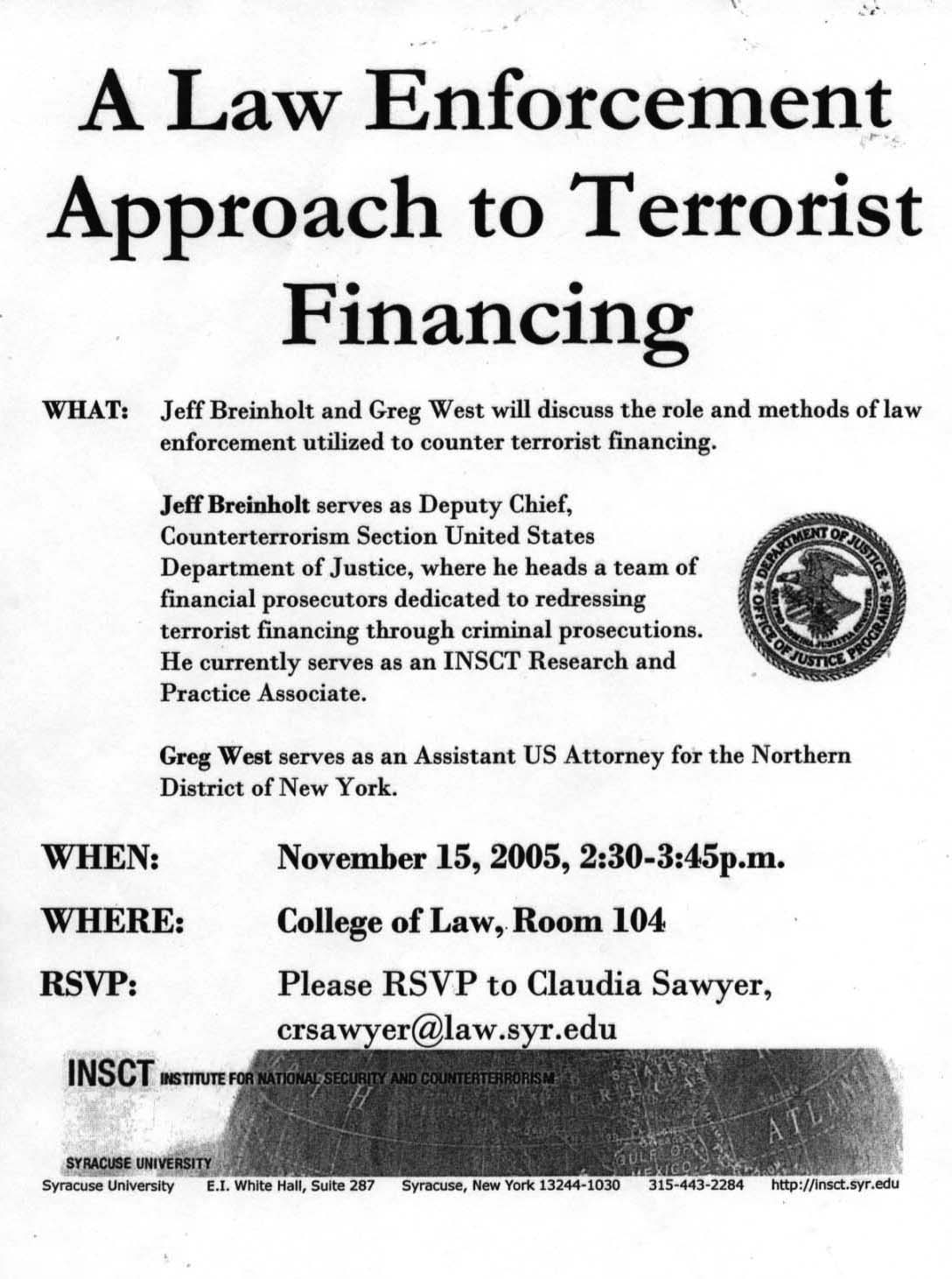
That the government strategy for prosecution was premeditated can be seen in a 2003 “Terrorist Financing” paper published shortly after Dhafir’s arrest. Written by Jeffrey Breinholt, then Coordinator of the Department of Justice Terrorist Financing Task Force and Research and Practice Associate at Syracuse University Institute for National Security and Counterterrorism (INSCT), it sets out the game plan for prosecutions.
In the introduction Breinholt says:
“Persons cannot be convicted of the federal crime of terrorism because there is no such crime. Instead, terrorism crimes have developed in the same manner as other crimes, policymakers determine what evil (or ‘mischief’) should be prevented, and then craft criminal laws that take into account how such mischief is generally achieved. On occasion, acts that are criminalized are not ones that should necessarily be discouraged, if committed by persons not otherwise involved in the targeted conduct. In such cases, laws are crafted to criminalize such conduct only in particular circumstances.” (p.3)
Within weeks of Dhafir’s sentencing to twenty-two years in prison, Breinholt presented a lecture containing the essence of this paper to a group of third-year law students at Syracuse University. Entitled “A Law Enforcement Approach to Terrorist Financing” it highlighted the Dhafir and HTN case. Greg West, one of the three HTN prosecutors, helped present the lecture, while the other two prosecutors, Michael Olmsted and Steve Green, were in attendance to answer questions. Law school faculty was also present along with representatives from the INSCT, a sponsor of the lecture.
Breinholt told the students that Dhafir’s case had been under-prosecuted and in the context of the lecture’s title the implication was clear: West told the class that one of the biggest frustrations of his career was having access to intelligence and not being able to share it. Breinholt enumerated the statutes being used as powerful tools for prosecution of terrorist financing and explained that these tools were not widely known even among prosecutors. He voiced a hope that law schools could serve as a kind of farm system educating students in this new field of law and that this in turn would create lawyers who would be familiar with and who could use these new prosecution tools.
He explained that because the “American public won’t tolerate anything less than the rule of law,” creative ways had to be figured out to draft laws that can be used to prosecute what they are trying to prevent. According to Breinholt, this task was addressed by a Department of Justice Terrorist Financing Task Force that came together to craft ways to apply white-collar expertise to the problem of terrorism. A major tool that emerged from the work of this task force, Breinholt told students, is the use of IEEPA violations to gain convictions in terrorist financing cases. He said that to convict under IEEPA all that was necessary was to build a chain of inferences from available circumstantial evidence.
Dhafir and other HTN defendants are listed on p.20 of Breinhot’s paper under the heading “Clean money cases.” Others under this heading include: Enaam Arnaout of Benevolence International Foundation (BIF); Sami Al-Hussayen, a graduate student at the University of Idaho, associated with Islamic Assembly of North America (IANA); Sami Al-Arian, a Palestinian professor from Florida; and the Holy Land Foundation, the biggest Muslim charity that was shuttered in 2001 but not prosecuted until six years later. (See Denial of Due Process To Muslims Disgraces Us All, for what happened to people in each of these cases. At the time of this article the HLF case had not yet been prosecuted. After being convicted in a second trial HLF’s two main principals each received 65 years, and three others received lesser sentences. )
Later in "Terrorism Financing," under the heading “Crimes of terrorist financing,” Breinholt lists the statutes used in prosecution of these cases. Statutes under this heading that were used in Dr. Dhafir’s case are 50 U.S.C. ss 1701,1702 (IEEPA) and U.S.C. ss 1956(a)(2)(A), “operating an unlicensed money transmitting business.”
Neither Breinholt nor West told the class that these “powerful prosecution tools” are being used mostly against Muslim charities and individuals associated with those charities, while violations by large corporations like Halliburton and Chevron Texaco, that did billions of dollars worth of business in defiance of IEEPA, go largely unpunished. At the most these corporations have gotten a slap on the wrist and a fine, but no individual board member or officer has ever faced prosecution. And although many non-Muslim charities work in the same troubled regions of the world as Muslim charities, not a single non-Muslim charity has been closed. None of this was mentioned at the lecture.
By hosting this lecture Syracuse University Law School gave credence to a charge never brought against Dhafir and HTN, and in doing so became an accomplice in the government’s subterfuge. After the lecture a request was made to Dean Hannah Arterian that (ACLU) court watchers who attended the trial be allowed to address the students; it was denied.
PREMEMPTIVE PROSECUTION: THE NEW PARADIGM
In the wake of 9/11 the FBI and Justice department indicated that their goal was to prevent terrorist attacks before they occurred by prosecuting under a new paradigm they called preemptive prosecution. The strategy used in the Dhafir and the HTN case is just one variant and the government has many tools in its arsenal to help gain successful prosecution. These include but are not limited to use of agent provocateurs/informants who help frame innocent Muslims and are rewarded with money and U.S. citizenship; use of staged press conferences and pre-trial publicity that hype unfounded and sensational terrorist allegations in order to scare communities, damage the reputation and credibility of Muslims, and influence the jury pool; use of strategies for intimidating juries into believing that the defendants are real terrorists by excessive security, by insisting on anonymous witnesses and/or jurors, and by constantly referring in trials to 9/11 and to known terrorists such as Osama bin Laden even when these references are irrelevant to the charges; excessive and inappropriate use of conspiracy charges and the use of guilt by association to smear those who have innocent contacts with known or suspected terrorists, including the accused having met these people years before they were labeled as such by the U.S. government; use of secret evidence and secret court opinions; and use of multiple trials – if it is unsuccessful in a first trial, the government keeps going until conviction is achieved either in a new trial or by coercing the defendant into a plea deal.
Project SALAM (Support and Legal Advocacy for Muslims), a group founded by two lawyers from one of these cases, has a database documenting these post-9/11 “terrorism-related” prosecutions that, “have included a significant number of Muslims and others who were severely overcharged and/or over sentenced.” Over the last 2 years Project SALAM has written a series of letters to President Obama and Attorney General Holder asking for review of these cases involving preemptive prosecution. It has yet to receive an answer.
Although this type of prosecution is currently being used mostly against Muslims and Arabs, it’s unlikely this will always be the case. A bill currently in the first step of the legislative process is titled in part “To direct the secretary of state to submit a report on whether any support organization that participated in the planning or execution of the recent Gaza flotilla attempt should be designated as a foreign terrorist organization…” If this bill passes and is used in conjunction with the recently passed National Defense Authorization Act (NDAA), which authorizes the U.S. military to indefinitely detain anyone suspected of being a terrorism supporter, many more humanitarians could find themselves in a similar situation to Dhafir.
COMMUNICATION MANAGEMENT UNITS
Dhafir has served most of his sentence in a Communication Management Unit (CMU) in Terre Haute, Indiana, that houses almost exclusively Muslim and/or Arab men, many of them principals of now defunct Muslim charities. There are currently two of these special units; the other located in Marion, Illinois. Conditions in these units are extreme: visiting and phone calls are severely restricted; no contact visits are allowed; units are equipped with 24-hour video surveillance that covers every inch of the facility; incoming and outgoing mail is monitored through Washington; and prisoners have no recourse to challenge their designation to these units.
The Terre Haute CMU is housed in the old death row building and had been vacant for a number of years before Muslim prisoners from all over the country were moved there in December 2006. Because the building is old and dilapidated, prisoners are subject to extreme heat in the summer and cold in the winter, including snow in some of the cells.
The Center for Constitutional Rights (CCR) sued the Bureau of Prisons (BOP) in March 2010 saying the units were unconstitutional, but the case is not resolved and prisoners are still being held there. On October 7, 2011, Members of Congress wrote a letter to the BOP expressing concern about policies and practices at the CMUs including the extraordinary restrictions on communications, lack of due process, and disproportionate number of Muslims being held there. They have not yet received a reply from the BOP.
RESENTENCING
A decision handed down by the Second Circuit Court of Appeals in August 2009 upheld Dhafir’s conviction, but suggested the district court look again at the Sentencing Guidelines. The Sentencing Guidelines range on which his sentence was based was erroneously increased as if he were a third-party (professional) money launderer rather than the reality, which showed that he transmitted funds derived from the very same offenses which he had been convicted for personally committing ("mail fraud" and "tax fraud"). Resentencing was scheduled for January 5, 2012, and just twelve days before it, Dhafir was suddenly moved out of the CMU into the general population at Terre Haute.
One might hope that this move is a preparation for release, but it’s more likely that it is in order to steal thunder from the seventy-five letters written to the Judge Mordue on Dhafir’s behalf telling of extreme conditions in the CMU and asking for clemency. People who have written to Judge Mordue on Dhafir’s behalf include Denis Halliday and Hans Von Sponeck, both of whom resigned from the UN because they were unwilling to implement a genocidal policy of sanctions against Iraq; Nobel Laureate Mairead Maguire; and many other individuals including members of Dr. Dhafir’s family, families of his former patients, people from his faith community, and people across the world who greatly appreciate his humanitarian outreach.
On December 28th 2011, Dhafir’s lawyer submitted his resentencing memo and letters. Perhaps because of the volume of letters, the following day the resentencing was postponed until February 3, 2012. A new prosecutor, who initially planned to rely on previous memos submitted by the prosecution, will submit a memo for this new date. (The two main members of the HTN prosecution team have moved on to new jobs: As mentioned above, former District Attorney Glenn Suddaby is now a federal judge, and prosecutor Michael Olmsted is now INTERPOL Special Representative to the United Nations, and gives talks about his prosecution of the HTN case.) The prosecution is asking that Dhafir be given more time, and the defense is hoping for immediate release or, at the very least, a significant sentence reduction. It remains to be seen if justice will finally be done in this case.
February 26, 2012, marks the ninth anniversary of Dhafir’s arrest and incarceration. He is in his sixties now and has a number of health issues that certainly affect his ability to endure the circumstances in which he is serving his sentence. He developed a heart condition after his arrest and has not always had the heart medication his condition requires. He’s also had two extremely painful episodes of gout that could easily have been prevented if he had been given medication. And he had to wait a long time to have a painful hernia treated, which has unfortunately now recurred, requiring further surgery. He will likely die in prison if he does not get relief at resentencing.
____________________________________________________________________________________________________________________________
Katherine Hughes has been passionate about the defense of civil liberties since seeing a documentary of the Allies going into Bergen-Belsen as a teenager 35 years ago. In the post-9/11 period she became alarmed at the demonization of Muslims and it was this that prompted her to attend Dhafir’s fourteen-week trial. She took notes every day and filled eight notebooks. Her website is: http://www.dhafirtrial.net/
“What was the result of Feb 26, 2003 besides imprisoning of innocent people? Scores of innocent elderly American cancer patients died needlessly, innumerable tens of thousands of Iraqi needy (children, women and men) died, and more than that suffered malnutrition and the humiliation of poverty. An entire segment of our society here was treated as criminals, intimidated, interrogated and threatened. Never in the history of the Islamic Society of Central New York had we had so many cases of depression and suicide that the mosque had to engage the services of a psychiatrist to help out. The dream of this Republic being a sanctuary for the oppressed was shattered on that day and a new sad reality was erected in its place.” Dr. Dhafir’s Sentencing Statement , p.36
At approximately 6.30 a.m. on February 26th 2003, upstate New York oncologist Dr. Rafil Dhafir pulled out of his driveway in Fayetteville heading to his practice in the underserved area of Rome; he has never returned. Just moments later he was pulled over and arrested by two federal investigators and a New York state trooper on charges that he had violated International Emergency Economic Powers Act (IEEPA) by sending food and medicine for thirteen years through his charity Help the Needy (HTN) to sick and starving Iraqi civilians. Back at the house he had just left, Mrs. Dhafir was now standing in her entryway with five guns pointed at her head after government agents broke down the door because she had failed to answer quickly enough.
In this operation code named Imminent Horizon four others associated with the charity were simultaneously arrested: two in the Syracuse area, one in Boise, Idaho, and one in Amman, Jordan. From 6 to 10 a.m. that Wednesday 150 local Muslim families were interrogated. Immigration agents visited non-citizens, FBI agents visited citizens, and IRS agents visited doctors' offices and other businesses.
As Kelly Tubbs, Dhafir’s office manager and transcriptionist, pulled into her usual parking spot, her car was immediately surrounded by gun-brandishing government agents in flak jackets. She attempted to introduce herself but the agents told her there was no need to since they knew exactly who she was. Well trained by Dhafir to take the utmost care of patients, she begged to be allowed to call to tell them not to come to the office. She was not allowed to. (Had the office been raided on a Friday, when staff had their office meeting, no patients would have been present.) Agents seized the office contents including all the patients' medical records. It took six weeks before patients received their records back.
The arrests were accompanied by a media circus: helicopters hovering over Dhafir’s house and all day-reports of the comings and goings of eighty federal agents. Attorney General John Ashcroft announced that “funders of terrorism have been arrested” and Governor George Pataki claimed the arrests proved the existence of “…terrorists living here in New York state among us…who are supporting or aiding and abetting those who would destroy our way of life and kill our friends and neighbors.”
Initially local prosecutors also followed the “terrorism” line and Assistant U.S. Attorney Greg West argued that because HTN defendant Ayman Jarwan had degrees in nuclear and radiological engineering he was capable of making a dirty bomb and therefore shouldn’t receive bail (he did). A groundswell of public support after the arrests meant that local prosecutors backed away from “terrorism” charges and instead said that Dhafir was a common thief. Dhafir was still held and denied bail on five occasions.
Seven government agencies had been conducting extensive surveillance on Dhafir and HTN for many years. They intercepted his mail, email, faxes and telephone calls; bugged his home, office, and hotel rooms; went through his trash; and conducted physical surveillance. On one occasion a hotel room in Washington D.C. was bugged and the government had seven translators listening in to the conversation (though none of the translators spoke Dhafir’s dialect). Nothing related to terrorism was uncovered and no charges of terrorism were ever brought against Dhafir.
The first indictment against Dhafir contained fourteen charges related only to the Iraq sanctions. Later, when Dhafir refused to accept a plea agreement, the government piled on more charges and he finally faced an indictment of sixty counts of white-collar crime at trial. State and national level government officials continued to tar Dhafir with the terrorism brush via the media, and just before his trial began when he had already been held for nineteen months, Governor Pataki described the case as a “money laundering case to help terrorist organizations … conduct horrible acts.” It was an announcement perfectly timed to reach potential jurors.
SHOW TRIAL
The trial was conducted on the twelfth floor of the Syracuse Federal Building, which was reached after passing two security points. Inside the courtroom there were two court guards who changed regularly, one at each exit. And because Dhafir would not submit to a strip search (on religious grounds) as he was ferried from prison to the trial, two federal marshals were also always present in the courtroom, one sitting adjacent to the jury and one directly behind Dhafir. There were five of these federal marshals who traded off approximately every forty minutes in full view of the jury. The changing of the guard took place at least 250 times during the proceedings and was a powerful non-verbal message to the jury.
Three prosecutors sat close to the jury while behind them, at another table, were three government agents who remained there throughout the trial except when they were testifying. FBI Agent Jim Kolbe testified for sixteen days, eight of them as the sole witness and eight of them as one of only two witnesses: it was his testimony that, essentially, convicted Dhafir. Social Security agent Michael McCole testified for about twenty minutes. The Defense Department agent, a young blonde woman who previously worked at the Syracuse Post-Standard, did not testify.
The defense team of Devereaux Cannick, Philip Gaynor, and Joel Cohen sat beyond the prosecution further away from the jury at two separate tables, one in front of the other. Dhafir mostly sat at the front table with whichever lawyer was cross-examining a witness, and the other two lawyers sat behind them. Cohen typed the proceeding on his laptop because the defense had no money for transcripts (at fifty cents a page) and the court had denied a request for transcripts at the expense of the court.
A motion granted by Judge Mordue before the trial began meant the defense could not challenge the government’s real reason for prosecuting Dhafir during proceedings. Such motions are often used in criminal trials by the defense to shield the jury from information that could be prejudicial to a defendant. Its use in this case had the opposite aim and effect: although prosecutors could hint at more serious (terrorism) charges throughout the trial, the defense team couldn't respond to these inflammatory innuendos head on.
Just days into the trial, FBI Agent Jim Kolbe told of items that had been found in the dumpster of an apartment building where HTN defendant Ayman Jarwan had been living. He described Islamic magazines showing military operations and said there was a gun cleaning kit also in the dumpster (this was later shown to be from a Thanksgiving hunting trip). When Cannick tried to explore this line of questioning the prosecution objected because a pre-trial motion it had been granted made this line of questioning inadmissible. The objection was upheld.
The defense objected and asked that the jury (and later Kolbe) leave the courtroom. In their absence, Gaynor argued that the defense should be allowed to follow up the line of questioning because it was the government that had introduced it. The defense aired other concerns about what they believed to be insinuation without proof by the government and then requested a mistrial because Kolbe’s testimony "left a ringing bell in the ears of jurors" with its powerful suggestion that Dhafir was still under investigation for more serious charges that were still pending. The request was denied.
At another point in the proceedings, the prosecution referred to the religious group of Islam that Osama Bin Laden was a member of, Salafi, and made the court aware that Dhafir was also a member of this particular Islamic religious tradition. (Salafi merely means a Muslim who is a strict adherent of the Koran and looks to the ancestors for guidance. It is comparable to someone in the Christian faith who looks to the Scriptures, Church Fathers, and traditions of the early church for guidance.)
Other testimony also hinted at more serious charges pending. Because the defense was not allowed to respond to these insinuations, the proceedings at times were surreal. This was the case in testimony of Colleen Williams, a tax preparer Dhafir had hired to help HTN sort out its tax returns and give advice on a 501(c)(3) application for the charity. (Up until then HTN had been under the 501(c)(3) umbrella of another charity, a not uncommon practice among charities. During the trial it became clear that the government had put a hold on the HTN application, preventing it from moving forward.) The government wanted Williams to inform on HTN and she described how FBI Agent Jim Kolbe, IRS Agent Mark Sweeney, and U.S. Attorney Brenda Sannes had spent three days, first individually and then together, asking her to wear a recorder in her meetings with HTN defendant Ayman Jarwan. She described them as “waving the flag” and telling her that, “9/11 may not have happened if people were involved.” She felt the HTN people “were being pursued” and got rid of them as a client after only three meetings. She never agreed to wear a wire and refused to refer the case to a government attorney.
The government called more than fifty witnesses to testify but neglected to call two key people: Kelly Tubbs, Dhafir’s office manager of ten years who was proud of the fact that Dhafir’s office had never failed an audit; and Maher Zagha, a co-defendant who was the HTN representative in Jordan. Zagha organized for food, clothing, and medicine to go by land and sea to Iraq. He also sent money to Dhafir’s elder brother (also a physician) in Baghdad so that animals could be bought, sacrificed, and given to the needy, particularly around Muslim holidays.
Arrested in Jordan on the same day as Dhafir’s arrest in the U.S., Zagha was held and questioned for three weeks by Jordanian authorities under FBI direction. In the end Jordanian authorities released him, satisfied that he had indeed sent aid to sick and starving Iraqi civilians on behalf of HTN. Zagha was presented as a fugitive at trial when, in fact, he was living in the house he had always lived in and would gladly have come to the U.S. to testify on Dhafir’s. Neither the prosecution nor the defense asked him to testify.
The government did not call Tubbs because it considered her a “hostile witness,” and, sadly, despite Tubbs calling the defense lawyers regularly asking to testify, they did not contact her either. The total extent of government’s reach in this case can be surmised by the surveillance conducted on Tubbs alone. Tubbs, who had nothing to do with HTN, had her home bugged and her telephone conversations monitored. On one occasion government agents even entered her house and copied her computer hard drive. Told of the bugging after Dhafir’s arrest, she and her husband began announcing their arrival when they got home, even alerting those “listening in” that they wouldn’t be able to hear anything on the evenings her husband’s band was practicing. She and her husband have since moved and although her experience has shaken her trust in the government to the core, her trust in Dhafir remains steadfast.
Witnesses who were obliged to testify against Dhafir in exchange for either immunity or a plea deal spoke of their respect for Dhafir and his kindness and generosity, often saying he was “like a father” or “like a brother” to them. Several Iraqi-born witnesses broke down on the stand as they talked conditions in Iraq during the sanctions. On the fourth day of the trial Walid Smare, a witness who had accepted immunity in exchange for his testimony, broke down as he was being cross-examined about circumstances of his family during the sanctions.
This prompted all hell to break loose in the courtroom: the government objected to its own witness crying, the defense objected to the government’s objection, and the witness insisted he wasn’t looking for sympathy. Once things calmed down, Judge Mordue, the presiding judge, instructed the jury, “[M]embers of the jury, we’re not here to judge whether it’s a noble thing in the world and the right thing, that’s fine. But the thing we’re here for is whether or not there’s been a violation of the law done according to what the allegations are by the government.”
A COMPLIANT MEDIA
The government was duplicitous in this case from the outset, yet no media outlet directly challenged the inconsistency. And because no terrorism charges were brought against Dhafir, only the local newspaper, the Syracuse Post-Standard, covered the trial. Prosecutors could not have written better articles themselves. Early in the trial the coverage prompted one of Dhafir’s three lawyers to write to the paper asking for better representation of defense cross-examination of witnesses. American Civil Liberties Union (ACLU) court watchers attending the trial also wrote letters asking the paper to give more balance in its coverage. And a multi-faith group who prayed together outside the courthouse each day before proceedings began met with editorial staff and was told that the defense’s side of the case would be more fully represented when it started calling its own witnesses.
In the fourteen-week trial the defense called one witness for fifteen minutes, Dr. Edward Cox, Director of Health Now, for Medicare, and his testimony appeared to confirm the defense reading of a rule in the Medicare Handbook on which all the Medicare counts rested. Next day the Post-Standard reported this testimony as it was given. However, the following day the paper ran a story on the front page, with a picture of Cox, in which he appeared to contradict his own testimony.
The paper did eventually give a couple of small challenges to the government duplicity in an editorial and a cartoon. Other than that it aided and abetted the government in transforming Dhafir’s image in the community from a compassionate humanitarian to a crook and supporter of terrorists.
BAIT AND SWITCH
In the end Dhafir was found guilty on fifty-nine counts of violations of the economic sanctions against Iraq; money laundering; mail and wire fraud; tax evasion; visa fraud (all of the above related to running HTN); and Medicare fraud. (The jury was not allowed to deliberate on one count in which the government had listed the wrong bank.)
Although the government acknowledged that Dhafir donated $1.4 million of his own money to HTN over the years, he was still convicted of spending more than $500,000 dollars of HTN money on himself and his friends. And despite receiving less reimbursement from Medicare for the previous year than he had spent on chemotherapy alone, he was convicted of Medicare fraud.
In 1993 Dhafir wrote a letter to Medicare complaining about its “ever-changing” rules and disrespect of his staff. For this action his office was put on a “pre-payment flag,” which meant that his office would not receive payment until someone at Medicare checked his office’s billing. At trial, the defense was unable to find out when, if ever, Dhafir’s office was taken off this flag. Medicare charges usually involve fictitious patients and made-up illnesses; Dhafir’s case had none of this. The government does not dispute that Dhafir’s patients received care and expensive chemotherapy; its argument for all twenty-five counts of Medicare fraud was that because Dhafir's Medicare claim forms had been filled out incorrectly, his office was not due any reimbursement for the treatment or chemotherapy his office had administered.
After the guilty verdicts came down, District Attorney Glenn Suddaby (now a federal judge) told reporters he didn’t want anyone saying anything about terrorism and that regardless of 9/11 this prosecution would have gone ahead. But six months later, on submitting a sentencing memo that asked for a sentence of not less than twenty-four years, he announced that Dhafir had links to terrorism. Dhafir and other HTN defendants are now listed on the government’s list of successful terrorism prosecutions along with Mrs. Dhafir and William Hatfield, Dhafir’s personal accountant.
The Post-Standard covered this announcement as if its reporter had not been present every day of the fourteen-week trial. A prominent front-page article with a very large headline announced, “U.S. Says Manlius Doctor Was Linked to Terrorists,” and a few pages later another headline announced “Prosecutors say video links Dhafir to al-Qaida founder.” The connection? On several occasions during the 1980s Dhafir was in Pakistan as a volunteer with Doctors Without Borders in mujahideen refugee camps. On one of these trips, he briefly met and interviewed Abdallah Azzam, who was later known as a teacher and mentor of Osama Bin Laden, and Gulbuddin Hekmatyar, future Taliban prime minister of Afghanistan. At the time Dhafir met these two, they were friends of the U.S. and the government even noted this in a footnote of its memo.
In fact they were very good friends of the U.S., which was funding them and other Afghan mujahedeen to the tune of millions of dollars to aid their fight against the Soviet Union. Throughout the 1980s both these people were welcomed to the U.S. and allowed to fundraise freely throughout its length and breadth. In 1985 Hekmatyar was part of a delegation of mujahideen leaders who came to U.S. to lobby diplomats at the U.N. General Assembly, and Ronald Reagan hosted this group of “freedom fighters” at the White House (although Hekmatyar declined to attend because he thought it would be bad for his image). Hekmatyar is a brutal warlord who killed and oppressed the Afghan people while in power and the U.S. is once again courting him as a partner who can help "bring stability” to the region.
CRIMINALIZING COMPASSION IN THE “WAR ON TERROR”
That the government strategy for prosecution was premeditated can be seen in a 2003 “Terrorist Financing” paper published shortly after Dhafir’s arrest. Written by Jeffrey Breinholt, then Coordinator of the Department of Justice Terrorist Financing Task Force and Research and Practice Associate at Syracuse University Institute for National Security and Counterterrorism (INSCT), it sets out the game plan for prosecutions.
In the introduction Breinholt says:
“Persons cannot be convicted of the federal crime of terrorism because there is no such crime. Instead, terrorism crimes have developed in the same manner as other crimes, policymakers determine what evil (or ‘mischief’) should be prevented, and then craft criminal laws that take into account how such mischief is generally achieved. On occasion, acts that are criminalized are not ones that should necessarily be discouraged, if committed by persons not otherwise involved in the targeted conduct. In such cases, laws are crafted to criminalize such conduct only in particular circumstances.” (p.3)
Within weeks of Dhafir’s sentencing to twenty-two years in prison, Breinholt presented a lecture containing the essence of this paper to a group of third-year law students at Syracuse University. Entitled “A Law Enforcement Approach to Terrorist Financing” it highlighted the Dhafir and HTN case. Greg West, one of the three HTN prosecutors, helped present the lecture, while the other two prosecutors, Michael Olmsted and Steve Green, were in attendance to answer questions. Law school faculty was also present along with representatives from the INSCT, a sponsor of the lecture.
Breinholt told the students that Dhafir’s case had been under-prosecuted and in the context of the lecture’s title the implication was clear: West told the class that one of the biggest frustrations of his career was having access to intelligence and not being able to share it. Breinholt enumerated the statutes being used as powerful tools for prosecution of terrorist financing and explained that these tools were not widely known even among prosecutors. He voiced a hope that law schools could serve as a kind of farm system educating students in this new field of law and that this in turn would create lawyers who would be familiar with and who could use these new prosecution tools.
He explained that because the “American public won’t tolerate anything less than the rule of law,” creative ways had to be figured out to draft laws that can be used to prosecute what they are trying to prevent. According to Breinholt, this task was addressed by a Department of Justice Terrorist Financing Task Force that came together to craft ways to apply white-collar expertise to the problem of terrorism. A major tool that emerged from the work of this task force, Breinholt told students, is the use of IEEPA violations to gain convictions in terrorist financing cases. He said that to convict under IEEPA all that was necessary was to build a chain of inferences from available circumstantial evidence.
Dhafir and other HTN defendants are listed on p.20 of Breinhot’s paper under the heading “Clean money cases.” Others under this heading include: Enaam Arnaout of Benevolence International Foundation (BIF); Sami Al-Hussayen, a graduate student at the University of Idaho, associated with Islamic Assembly of North America (IANA); Sami Al-Arian, a Palestinian professor from Florida; and the Holy Land Foundation, the biggest Muslim charity that was shuttered in 2001 but not prosecuted until six years later. (See Denial of Due Process To Muslims Disgraces Us All, for what happened to people in each of these cases. At the time of this article the HLF case had not yet been prosecuted. After being convicted in a second trial HLF’s two main principals each received 65 years, and three others received lesser sentences. )
Later in "Terrorism Financing," under the heading “Crimes of terrorist financing,” Breinholt lists the statutes used in prosecution of these cases. Statutes under this heading that were used in Dr. Dhafir’s case are 50 U.S.C. ss 1701,1702 (IEEPA) and U.S.C. ss 1956(a)(2)(A), “operating an unlicensed money transmitting business.”
Neither Breinholt nor West told the class that these “powerful prosecution tools” are being used mostly against Muslim charities and individuals associated with those charities, while violations by large corporations like Halliburton and Chevron Texaco, that did billions of dollars worth of business in defiance of IEEPA, go largely unpunished. At the most these corporations have gotten a slap on the wrist and a fine, but no individual board member or officer has ever faced prosecution. And although many non-Muslim charities work in the same troubled regions of the world as Muslim charities, not a single non-Muslim charity has been closed. None of this was mentioned at the lecture.
By hosting this lecture Syracuse University Law School gave credence to a charge never brought against Dhafir and HTN, and in doing so became an accomplice in the government’s subterfuge. After the lecture a request was made to Dean Hannah Arterian that (ACLU) court watchers who attended the trial be allowed to address the students; it was denied.
PREMEMPTIVE PROSECUTION: THE NEW PARADIGM
In the wake of 9/11 the FBI and Justice department indicated that their goal was to prevent terrorist attacks before they occurred by prosecuting under a new paradigm they called preemptive prosecution. The strategy used in the Dhafir and the HTN case is just one variant and the government has many tools in its arsenal to help gain successful prosecution. These include but are not limited to use of agent provocateurs/informants who help frame innocent Muslims and are rewarded with money and U.S. citizenship; use of staged press conferences and pre-trial publicity that hype unfounded and sensational terrorist allegations in order to scare communities, damage the reputation and credibility of Muslims, and influence the jury pool; use of strategies for intimidating juries into believing that the defendants are real terrorists by excessive security, by insisting on anonymous witnesses and/or jurors, and by constantly referring in trials to 9/11 and to known terrorists such as Osama bin Laden even when these references are irrelevant to the charges; excessive and inappropriate use of conspiracy charges and the use of guilt by association to smear those who have innocent contacts with known or suspected terrorists, including the accused having met these people years before they were labeled as such by the U.S. government; use of secret evidence and secret court opinions; and use of multiple trials – if it is unsuccessful in a first trial, the government keeps going until conviction is achieved either in a new trial or by coercing the defendant into a plea deal.
Project SALAM (Support and Legal Advocacy for Muslims), a group founded by two lawyers from one of these cases, has a database documenting these post-9/11 “terrorism-related” prosecutions that, “have included a significant number of Muslims and others who were severely overcharged and/or over sentenced.” Over the last 2 years Project SALAM has written a series of letters to President Obama and Attorney General Holder asking for review of these cases involving preemptive prosecution. It has yet to receive an answer.
Although this type of prosecution is currently being used mostly against Muslims and Arabs, it’s unlikely this will always be the case. A bill currently in the first step of the legislative process is titled in part “To direct the secretary of state to submit a report on whether any support organization that participated in the planning or execution of the recent Gaza flotilla attempt should be designated as a foreign terrorist organization…” If this bill passes and is used in conjunction with the recently passed National Defense Authorization Act (NDAA), which authorizes the U.S. military to indefinitely detain anyone suspected of being a terrorism supporter, many more humanitarians could find themselves in a similar situation to Dhafir.
COMMUNICATION MANAGEMENT UNITS
Dhafir has served most of his sentence in a Communication Management Unit (CMU) in Terre Haute, Indiana, that houses almost exclusively Muslim and/or Arab men, many of them principals of now defunct Muslim charities. There are currently two of these special units; the other located in Marion, Illinois. Conditions in these units are extreme: visiting and phone calls are severely restricted; no contact visits are allowed; units are equipped with 24-hour video surveillance that covers every inch of the facility; incoming and outgoing mail is monitored through Washington; and prisoners have no recourse to challenge their designation to these units.
The Terre Haute CMU is housed in the old death row building and had been vacant for a number of years before Muslim prisoners from all over the country were moved there in December 2006. Because the building is old and dilapidated, prisoners are subject to extreme heat in the summer and cold in the winter, including snow in some of the cells.
The Center for Constitutional Rights (CCR) sued the Bureau of Prisons (BOP) in March 2010 saying the units were unconstitutional, but the case is not resolved and prisoners are still being held there. On October 7, 2011, Members of Congress wrote a letter to the BOP expressing concern about policies and practices at the CMUs including the extraordinary restrictions on communications, lack of due process, and disproportionate number of Muslims being held there. They have not yet received a reply from the BOP.
RESENTENCING
A decision handed down by the Second Circuit Court of Appeals in August 2009 upheld Dhafir’s conviction, but suggested the district court look again at the Sentencing Guidelines. The Sentencing Guidelines range on which his sentence was based was erroneously increased as if he were a third-party (professional) money launderer rather than the reality, which showed that he transmitted funds derived from the very same offenses which he had been convicted for personally committing ("mail fraud" and "tax fraud"). Resentencing was scheduled for January 5, 2012, and just twelve days before it, Dhafir was suddenly moved out of the CMU into the general population at Terre Haute.
One might hope that this move is a preparation for release, but it’s more likely that it is in order to steal thunder from the seventy-five letters written to the Judge Mordue on Dhafir’s behalf telling of extreme conditions in the CMU and asking for clemency. People who have written to Judge Mordue on Dhafir’s behalf include Denis Halliday and Hans Von Sponeck, both of whom resigned from the UN because they were unwilling to implement a genocidal policy of sanctions against Iraq; Nobel Laureate Mairead Maguire; and many other individuals including members of Dr. Dhafir’s family, families of his former patients, people from his faith community, and people across the world who greatly appreciate his humanitarian outreach.
On December 28th 2011, Dhafir’s lawyer submitted his resentencing memo and letters. Perhaps because of the volume of letters, the following day the resentencing was postponed until February 3, 2012. A new prosecutor, who initially planned to rely on previous memos submitted by the prosecution, will submit a memo for this new date. (The two main members of the HTN prosecution team have moved on to new jobs: As mentioned above, former District Attorney Glenn Suddaby is now a federal judge, and prosecutor Michael Olmsted is now INTERPOL Special Representative to the United Nations, and gives talks about his prosecution of the HTN case.) The prosecution is asking that Dhafir be given more time, and the defense is hoping for immediate release or, at the very least, a significant sentence reduction. It remains to be seen if justice will finally be done in this case.
February 26, 2012, marks the ninth anniversary of Dhafir’s arrest and incarceration. He is in his sixties now and has a number of health issues that certainly affect his ability to endure the circumstances in which he is serving his sentence. He developed a heart condition after his arrest and has not always had the heart medication his condition requires. He’s also had two extremely painful episodes of gout that could easily have been prevented if he had been given medication. And he had to wait a long time to have a painful hernia treated, which has unfortunately now recurred, requiring further surgery. He will likely die in prison if he does not get relief at resentencing.
____________________________________________________________________________________________________________________________
Katherine Hughes has been passionate about the defense of civil liberties since seeing a documentary of the Allies going into Bergen-Belsen as a teenager 35 years ago. In the post-9/11 period she became alarmed at the demonization of Muslims and it was this that prompted her to attend Dhafir’s fourteen-week trial. She took notes every day and filled eight notebooks. Her website is: http://www.dhafirtrial.net/
Iran’s Bomb: Haven’t We Been Here Before?
Iran’s Bomb: Haven’t We Been Here Before?
By William Fisher
I am far from any kind of expert in nuclear weapons development, so I could be 180 degrees wrong. But I have a growing sense that the increasingly ominous reports about Iran’s A-bomb aspirations mimic a story I’ve heard before.
It was in 2002 and 2003, when the drumbeats of impending war were being heard from our political leaders and dutifully transcribed by most (though not all) of the supine bunch of stenographers we call the mainstream press.
Although many analysts at the CIA were skeptical, the dominant narrative in Washington was that Saddam Hussein not only had weapons of mass destruction, but he had stockpiles of them. You just about had to go to the “alternative” press on the Internet to hear any other side of the story.
The incessant drip-drip-drip from the Bush-Cheney propaganda machine, including allusions to the mushroom cloud, stirred up a witch’s brew of fear among the population. And that fear was constantly being stoked into hysteria, bases of the certitude that Saddam Hussein played a big part in 9/11 – didn’t he meet with some al Qaeda agent in Vienna? -- and the display of actual weapons parts by Colin Powell at the UN. And Colin Powell was a man we had all come to trust and respect, wasn’t he?
Well, I’m getting a feeling of deja vu all over again listening to Administration officials talking about whether Iran will have its bomb in a year or two years, the US assuring the Ayatollahs that no aspect of American power was off the table, the Israelis releasing their crop of “top secrets everyone should know” to talk about when and if they’re planning to bomb Iranian nuclear installations. Just listen to Israeli Defense Minister Ehud Barak, who claims Israel “does not want to take military action against Iran
over its nuclear program, but at some point may have no other option. The
Jewish state at this point did not intend to launch a strike against Iranian nuclear facilities, but retained the option as a 'last resort,'
And, in case you haven’t noticed, this main narrative is being burnished on a pretty regular basis by other scary-sounding developments by both sides, or all three sides. The Iranians hatched a plot to kill the Saudi Ambassador to Washington in the U.S. Unexplained explosions ripped through one of Iran’s major nuclear installations. The Iranians sentenced an American to death for spying for the Israelis. Then they threatened to close the Straight of Hormuz, through which passes a big chunk of petroleum that’s shipped by sea. The Iranians were also busy discussing cutting off oil supplies to Europe, and the West was conjuring up ever more draconian sanctions.
But are we being sandbagged again? Doesn’t anyone disagree with the conclusions reached by the US and Israeli administrations? Well, yes, lots of them, but people’s misgivings are being reported in only a tiny fraction of the mainstream press, and they’re difficult to find.
For example, Whistleblower Sibel Edmunds’ Web site, Boiling Frogs, brings us an article by William Blum, for many years one of the most credible critics of US foreign policy.
“Is USrael (Blum uses this contraction to indicate the two nations’ singularity of purpose) actually fearful of an attack from a nuclear-armed Iran?” Blum asks.
He answers: “In case you’ve forgotten…In 2007, in a closed discussion, Israeli Foreign Minister Tzipi Livni said that in her opinion “Iranian nuclear weapons do not pose an existential threat to Israel.” She “also criticized the exaggerated use that [then Israeli] Prime Minister Ehud Olmert is making of the issue of the Iranian bomb, claiming that he is attempting to rally the public around him by playing on its most basic fears.”
He goes on: In 2009, “A senior Israeli official in Washington” asserted that “Iran would be unlikely to use its missiles in an attack [against Israel] because of the certainty of retaliation.”
And in 2010, “The Sunday Times of London (January 10) reported that Brigadier-General Uzi Eilam, war hero, pillar of the Israeli defense establishment, and former director-general of Israel’s Atomic Energy Commission, ‘believes it will probably take Iran seven years to make nuclear weapons’.”
Early last month, Blum continues, “US Secretary of Defense Leon Panetta told a television audience: “Are they [Iran] trying to develop a nuclear weapon? No, but we know that they’re trying to develop a nuclear capability.”
“A week later we could read in the New York Times (January 15) that “three leading Israeli security experts — the Mossad chief, Tamir Pardo, a former Mossad chief, Efraim Halevy, and a former military chief of staff, Dan Halutz — all recently declared that a nuclear Iran would not pose an existential threat to Israel.”
Then, a few days afterward, Israeli Defense Minister Ehud Barak, in an interview with Israeli Army Radio (January 18), had this exchange:
Question: Is it Israel’s judgment that Iran has not yet decided to turn its nuclear potential into weapons of mass destruction?
Barak: “People ask whether Iran is determined to break out from the control [inspection] regime right now … in an attempt to obtain nuclear weapons or an operable installation as quickly as possible. Apparently that is not the case.”
Lastly, we have the US Director of National Intelligence, James Clapper, in a report to Congress: “We do not know, however, if Iran will eventually decide to build nuclear weapons. … There are “certain things [the Iranians] have not done” that would be necessary to build a warhead.
Blum concludes: “Admissions like the above — and there are others — are never put into headlines by the American mass media; indeed, only very lightly reported at all; and sometimes distorted — On the Public Broadcasting System (PBS News Hour, January 9), the non-commercial network much beloved by American liberals, the Panetta quote above was reported as: “But we know that they’re trying to develop a nuclear capability, and that’s what concerns us.” Flagrantly omitted were the preceding words: “Are they trying to develop a nuclear weapon? No …”
Blum’s article contains much more valuable information than we have space for. His piece may be found at: http://www.boilingfrogspost.com/2012/02/04/war-on-iran-propaganda-the-lord-high-almighty-pooh-bah-of-threats/
Nobody believes Iran with a nuclear weapon would be a plus for Iran or its neighbors, or for the Israelis or the US. Let us await the IAEA’S report at the conclusion of its current inspection. Then we should press the Iranians to sit down with the Quartet for a serious discussion, not only of the nuclear issue, but of a whole range of issues – notably to include human rights – that separate the two countries today.
Republicans will rail against any kind of talking with the Iranians. But they’ll rail whether we talk or not. So let’s hope the Iranians are feeling the sanctions enough to want to sit down with the UN, the US, France and Germany, and take at least some baby steps.
By William Fisher
I am far from any kind of expert in nuclear weapons development, so I could be 180 degrees wrong. But I have a growing sense that the increasingly ominous reports about Iran’s A-bomb aspirations mimic a story I’ve heard before.
It was in 2002 and 2003, when the drumbeats of impending war were being heard from our political leaders and dutifully transcribed by most (though not all) of the supine bunch of stenographers we call the mainstream press.
Although many analysts at the CIA were skeptical, the dominant narrative in Washington was that Saddam Hussein not only had weapons of mass destruction, but he had stockpiles of them. You just about had to go to the “alternative” press on the Internet to hear any other side of the story.
The incessant drip-drip-drip from the Bush-Cheney propaganda machine, including allusions to the mushroom cloud, stirred up a witch’s brew of fear among the population. And that fear was constantly being stoked into hysteria, bases of the certitude that Saddam Hussein played a big part in 9/11 – didn’t he meet with some al Qaeda agent in Vienna? -- and the display of actual weapons parts by Colin Powell at the UN. And Colin Powell was a man we had all come to trust and respect, wasn’t he?
Well, I’m getting a feeling of deja vu all over again listening to Administration officials talking about whether Iran will have its bomb in a year or two years, the US assuring the Ayatollahs that no aspect of American power was off the table, the Israelis releasing their crop of “top secrets everyone should know” to talk about when and if they’re planning to bomb Iranian nuclear installations. Just listen to Israeli Defense Minister Ehud Barak, who claims Israel “does not want to take military action against Iran
over its nuclear program, but at some point may have no other option. The
Jewish state at this point did not intend to launch a strike against Iranian nuclear facilities, but retained the option as a 'last resort,'
And, in case you haven’t noticed, this main narrative is being burnished on a pretty regular basis by other scary-sounding developments by both sides, or all three sides. The Iranians hatched a plot to kill the Saudi Ambassador to Washington in the U.S. Unexplained explosions ripped through one of Iran’s major nuclear installations. The Iranians sentenced an American to death for spying for the Israelis. Then they threatened to close the Straight of Hormuz, through which passes a big chunk of petroleum that’s shipped by sea. The Iranians were also busy discussing cutting off oil supplies to Europe, and the West was conjuring up ever more draconian sanctions.
But are we being sandbagged again? Doesn’t anyone disagree with the conclusions reached by the US and Israeli administrations? Well, yes, lots of them, but people’s misgivings are being reported in only a tiny fraction of the mainstream press, and they’re difficult to find.
For example, Whistleblower Sibel Edmunds’ Web site, Boiling Frogs, brings us an article by William Blum, for many years one of the most credible critics of US foreign policy.
“Is USrael (Blum uses this contraction to indicate the two nations’ singularity of purpose) actually fearful of an attack from a nuclear-armed Iran?” Blum asks.
He answers: “In case you’ve forgotten…In 2007, in a closed discussion, Israeli Foreign Minister Tzipi Livni said that in her opinion “Iranian nuclear weapons do not pose an existential threat to Israel.” She “also criticized the exaggerated use that [then Israeli] Prime Minister Ehud Olmert is making of the issue of the Iranian bomb, claiming that he is attempting to rally the public around him by playing on its most basic fears.”
He goes on: In 2009, “A senior Israeli official in Washington” asserted that “Iran would be unlikely to use its missiles in an attack [against Israel] because of the certainty of retaliation.”
And in 2010, “The Sunday Times of London (January 10) reported that Brigadier-General Uzi Eilam, war hero, pillar of the Israeli defense establishment, and former director-general of Israel’s Atomic Energy Commission, ‘believes it will probably take Iran seven years to make nuclear weapons’.”
Early last month, Blum continues, “US Secretary of Defense Leon Panetta told a television audience: “Are they [Iran] trying to develop a nuclear weapon? No, but we know that they’re trying to develop a nuclear capability.”
“A week later we could read in the New York Times (January 15) that “three leading Israeli security experts — the Mossad chief, Tamir Pardo, a former Mossad chief, Efraim Halevy, and a former military chief of staff, Dan Halutz — all recently declared that a nuclear Iran would not pose an existential threat to Israel.”
Then, a few days afterward, Israeli Defense Minister Ehud Barak, in an interview with Israeli Army Radio (January 18), had this exchange:
Question: Is it Israel’s judgment that Iran has not yet decided to turn its nuclear potential into weapons of mass destruction?
Barak: “People ask whether Iran is determined to break out from the control [inspection] regime right now … in an attempt to obtain nuclear weapons or an operable installation as quickly as possible. Apparently that is not the case.”
Lastly, we have the US Director of National Intelligence, James Clapper, in a report to Congress: “We do not know, however, if Iran will eventually decide to build nuclear weapons. … There are “certain things [the Iranians] have not done” that would be necessary to build a warhead.
Blum concludes: “Admissions like the above — and there are others — are never put into headlines by the American mass media; indeed, only very lightly reported at all; and sometimes distorted — On the Public Broadcasting System (PBS News Hour, January 9), the non-commercial network much beloved by American liberals, the Panetta quote above was reported as: “But we know that they’re trying to develop a nuclear capability, and that’s what concerns us.” Flagrantly omitted were the preceding words: “Are they trying to develop a nuclear weapon? No …”
Blum’s article contains much more valuable information than we have space for. His piece may be found at: http://www.boilingfrogspost.com/2012/02/04/war-on-iran-propaganda-the-lord-high-almighty-pooh-bah-of-threats/
Nobody believes Iran with a nuclear weapon would be a plus for Iran or its neighbors, or for the Israelis or the US. Let us await the IAEA’S report at the conclusion of its current inspection. Then we should press the Iranians to sit down with the Quartet for a serious discussion, not only of the nuclear issue, but of a whole range of issues – notably to include human rights – that separate the two countries today.
Republicans will rail against any kind of talking with the Iranians. But they’ll rail whether we talk or not. So let’s hope the Iranians are feeling the sanctions enough to want to sit down with the UN, the US, France and Germany, and take at least some baby steps.
Saturday, January 28, 2012
What We Left Behind in Iraq
By William Fisher
Human Rights Watch is charging that, despite U.S. government assurances that it helped create a stable democracy, the reality is that it left behind a “budding police state” -- cracking down harshly during 2011 on freedom of expression and assembly by intimidating, beating, and detaining activists, demonstrators, and journalists.
The organization’s Middle East and North Africa director, Sarah Leah Whitson, warns that “Iraq is quickly slipping back into authoritarianism as its security forces abuse protesters, harass journalists, and torture detainees.”
Its World Report 2012 attributes the downward trajectory to the security services of Prime Minister Nuri al-Maliki” and armed gangs.
The report notes that in February, HRW “uncovered a secret detention facility controlled by elite security forces who report to the military office of the Prime Minister. The report added, “The same elite divisions controlled Camp Honor, a separate facility in Baghdad where detainees were tortured with impunity.”
The 676-page report report says, “Given the violent forces resisting the “Arab Spring,” the international community has an important role to play in assisting the birth of rights-respecting democracies in the region.”
The report documents a wide range of human rights abuses. For example, it says, “In the weeks before the last convoy of US troops left Iraq on December 18, Iraqi security forces rounded up hundreds of Iraqis accused of being former Baath Party members, most of whom remain in detention without charge.”
The pullout of U.S. troops has been marked by an “apolitical crisis and a series of terrorist attacks targeting civilians that have rocked the country.” But Iraqi-on-Iraqi violence is not new and is unconnected to the US exit. A number of US Embassy cables released by Wikileaks refer to the torture of prisoners in Iraqi custody and of knowledge of some of it by US troops.
The annual report, which covers the state of human rights in some 90 countries, says that, during nationwide demonstrations in Iraq to “protest widespread corruption and demand greater civil and political rights,” security forces “violently dispersed protesters, killing at least 12 on February 25, and injuring more than 100. Baghdad security forces beat unarmed journalists and protesters that day, smashing cameras and confiscating memory cards.”
Earlier in the year, “in one of the worst incidents, government-backed thugs armed with wooden planks, knives, and iron pipes, beat and stabbed peaceful protesters and sexually molested female demonstrators as security forces stood by and watched, sometimes laughing at the victims,” the report charges.
In May, the report says, the Council of Ministers approved a Law on the Freedom of Expression of Opinion, Assembly, and Peaceful Demonstration, which “authorizes officials to restrict freedom of assembly to protect ‘the public interest’ and in the interest of ‘general order or public morals.’ This law still awaits parliamentary approval.
HRW comments that freedom of expression fared little better as “security forces routinely abused journalists covering demonstrations, using threats, arbitrary arrests, beatings, and harassment, and confiscating or destroying their equipment.”
On September 8, the report says, “An unknown assailant shot to death Hadi al-Mahdi, a popular radio journalist often critical of government corruption and social inequality, at his home in Baghdad. Immediately before his death, HRW says al-Mahdi had received several phone and text message threats not to return to Baghdad’s Tahrir Square, which was the focal point for the weekly demonstrations.”
Earlier, after attending the February 25 “Day of Anger” mass demonstration, security forces arrested, blindfolded, and severely beat him and three other journalists during a subsequent interrogation,” HRW says.
In January 2012, HRW says it “observed that Iraqi authorities had successfully curtailed the Tahrir Square anti-government demonstrations by flooding the weekly protests with pro-government supporters and undercover security agents. Dissenting activists and independent journalists for the most part said that they no longer felt safe attending the demonstrations.”
The report continues, “Prison brutality, including torture in detention facilities, was a major problem throughout the year. In February, Human Rights Watch uncovered, within the Camp Justice military base in Baghdad, a secret detention facility controlled by elite security forces who report to al-Maliki’s military office.”
Beginning in late 2010, the report charges, Iraqi authorities transferred more than 280 detainees to the facility, which was controlled by the Army’s 56th Brigade and the Counter-Terrorism Service.
HRW added that “the same elite divisions controlled Camp Honor, a separate facility in Baghdad where detainees were tortured with impunity. More than a dozen former Camp Honor detainees told Human Rights Watch that detainees were held incommunicado and in inhumane conditions, many for months at a time. Detainees said interrogators beat them; hung them upside down for hours at a time; administered electric shocks to various body parts, including the genitals; and repeatedly put plastic bags over their heads until they passed out from asphyxiation.”
HRW also weighed in on the human rights situation in Iraqi Kurdistan. In what it called the “Silenced Spring,” HRW’s Samer Muscati recounts that the Kurdistan Regional Government “promised a new era of freedom for Iraqi Kurds, but it seems no more respectful of Kurdish rights to free speech than the government that preceded it.”
He added, “In a time when the Middle East is erupting in demands to end repression, the Kurdish authorities are trying to stifle and intimidate critical journalism.”
In March, Human Rights Watch interviewed more than 20 journalists in Kurdistan covering the protests and found that security forces and their proxies routinely repress journalists through threats, arbitrary arrests, beatings, and harassment, and by confiscating and destroying their equipment.
And Iraqi authorities appear to be pulling no punches. Zana Ali Ghazi, 32, a reporter for the Kurdistan News Network (KNN), a satellite television channel affiliated with the Kurdish opposition party, Goran, said that while he was trying to report on a protest in the city of Saeed Sadiq on March 15, “eight armed men, some in uniform, cracked three of his ribs and beat him with wooden clubs and Kalashnikovs until he lost consciousness. ‘They told me that if I continued to cover this type of news, they would kill me’,” Ghazi told HRW.
Kurdistan authorities have repeatedly tried to silence Livin Magazine, one of Iraqi Kurdistan's leading independent publications, and other media. The international community should end its silence and condemn these widening attacks, Human Rights Watch said.
A Livin reporter told Human Rights Watch that when he called the Minister of Peshmerga (Kurdistan security forces), on April 24, the minister threatened Livin's editor, Mira, with death. The reporter says the conversation is on tape but that no one from the Iraqi authorities had made any move to investigate.
In Sulaimaniya on the night of May 11, security forces detained and beat a Kurdistan News Network reporter, Bryar Namiq, breaking his hand.
In Arbil, two journalists, who HRW says are afraid to be named for fear of reprisal, charged that on May 18 eight men in civilian clothes chased after them in late April. The men appeared in two vehicles on the street just before the journalists were supposed to meet with a regional official who had asked for a meeting with some members of the media.
HRW says the journalists believe that the men were plainclothes security forces who were aware of the meeting and were trying to kidnap them.
The HRW Report says that Soran Umar, a protest organizer and freelance journalist, has been in hiding since April 19. "I have not slept at home since then," he told Human Rights Watch on May 17. "My sin is that I am criticizing the undemocratic acts of KRG and the two ruling parties, that is all. The security forces have tried to kidnap me, and they have ordered my arrest. They even tried to kidnap my son."
These examples appear to be a small fraction of abuses carried out by Iraqi government authorities against journalists -- Reporters Without Borders has tallied 44 physical attacks against media workers and outlets and 23 arrests.
Which prompted this thought from HRW’s Sarah Leah Whitson: "Eight years after the United States removed Saddam Hussein in the name of protecting the rights of Kurds, it is standing by silently as the government it
helped to install in Kurdistan abuses and represses the population. US President Obama noted in his speech on May 20 the flourishing democracy in Iraq, but the reality is that government-sponsored fear and
repression continue to fester there."
Human Rights Watch is charging that, despite U.S. government assurances that it helped create a stable democracy, the reality is that it left behind a “budding police state” -- cracking down harshly during 2011 on freedom of expression and assembly by intimidating, beating, and detaining activists, demonstrators, and journalists.
The organization’s Middle East and North Africa director, Sarah Leah Whitson, warns that “Iraq is quickly slipping back into authoritarianism as its security forces abuse protesters, harass journalists, and torture detainees.”
Its World Report 2012 attributes the downward trajectory to the security services of Prime Minister Nuri al-Maliki” and armed gangs.
The report notes that in February, HRW “uncovered a secret detention facility controlled by elite security forces who report to the military office of the Prime Minister. The report added, “The same elite divisions controlled Camp Honor, a separate facility in Baghdad where detainees were tortured with impunity.”
The 676-page report report says, “Given the violent forces resisting the “Arab Spring,” the international community has an important role to play in assisting the birth of rights-respecting democracies in the region.”
The report documents a wide range of human rights abuses. For example, it says, “In the weeks before the last convoy of US troops left Iraq on December 18, Iraqi security forces rounded up hundreds of Iraqis accused of being former Baath Party members, most of whom remain in detention without charge.”
The pullout of U.S. troops has been marked by an “apolitical crisis and a series of terrorist attacks targeting civilians that have rocked the country.” But Iraqi-on-Iraqi violence is not new and is unconnected to the US exit. A number of US Embassy cables released by Wikileaks refer to the torture of prisoners in Iraqi custody and of knowledge of some of it by US troops.
The annual report, which covers the state of human rights in some 90 countries, says that, during nationwide demonstrations in Iraq to “protest widespread corruption and demand greater civil and political rights,” security forces “violently dispersed protesters, killing at least 12 on February 25, and injuring more than 100. Baghdad security forces beat unarmed journalists and protesters that day, smashing cameras and confiscating memory cards.”
Earlier in the year, “in one of the worst incidents, government-backed thugs armed with wooden planks, knives, and iron pipes, beat and stabbed peaceful protesters and sexually molested female demonstrators as security forces stood by and watched, sometimes laughing at the victims,” the report charges.
In May, the report says, the Council of Ministers approved a Law on the Freedom of Expression of Opinion, Assembly, and Peaceful Demonstration, which “authorizes officials to restrict freedom of assembly to protect ‘the public interest’ and in the interest of ‘general order or public morals.’ This law still awaits parliamentary approval.
HRW comments that freedom of expression fared little better as “security forces routinely abused journalists covering demonstrations, using threats, arbitrary arrests, beatings, and harassment, and confiscating or destroying their equipment.”
On September 8, the report says, “An unknown assailant shot to death Hadi al-Mahdi, a popular radio journalist often critical of government corruption and social inequality, at his home in Baghdad. Immediately before his death, HRW says al-Mahdi had received several phone and text message threats not to return to Baghdad’s Tahrir Square, which was the focal point for the weekly demonstrations.”
Earlier, after attending the February 25 “Day of Anger” mass demonstration, security forces arrested, blindfolded, and severely beat him and three other journalists during a subsequent interrogation,” HRW says.
In January 2012, HRW says it “observed that Iraqi authorities had successfully curtailed the Tahrir Square anti-government demonstrations by flooding the weekly protests with pro-government supporters and undercover security agents. Dissenting activists and independent journalists for the most part said that they no longer felt safe attending the demonstrations.”
The report continues, “Prison brutality, including torture in detention facilities, was a major problem throughout the year. In February, Human Rights Watch uncovered, within the Camp Justice military base in Baghdad, a secret detention facility controlled by elite security forces who report to al-Maliki’s military office.”
Beginning in late 2010, the report charges, Iraqi authorities transferred more than 280 detainees to the facility, which was controlled by the Army’s 56th Brigade and the Counter-Terrorism Service.
HRW added that “the same elite divisions controlled Camp Honor, a separate facility in Baghdad where detainees were tortured with impunity. More than a dozen former Camp Honor detainees told Human Rights Watch that detainees were held incommunicado and in inhumane conditions, many for months at a time. Detainees said interrogators beat them; hung them upside down for hours at a time; administered electric shocks to various body parts, including the genitals; and repeatedly put plastic bags over their heads until they passed out from asphyxiation.”
HRW also weighed in on the human rights situation in Iraqi Kurdistan. In what it called the “Silenced Spring,” HRW’s Samer Muscati recounts that the Kurdistan Regional Government “promised a new era of freedom for Iraqi Kurds, but it seems no more respectful of Kurdish rights to free speech than the government that preceded it.”
He added, “In a time when the Middle East is erupting in demands to end repression, the Kurdish authorities are trying to stifle and intimidate critical journalism.”
In March, Human Rights Watch interviewed more than 20 journalists in Kurdistan covering the protests and found that security forces and their proxies routinely repress journalists through threats, arbitrary arrests, beatings, and harassment, and by confiscating and destroying their equipment.
And Iraqi authorities appear to be pulling no punches. Zana Ali Ghazi, 32, a reporter for the Kurdistan News Network (KNN), a satellite television channel affiliated with the Kurdish opposition party, Goran, said that while he was trying to report on a protest in the city of Saeed Sadiq on March 15, “eight armed men, some in uniform, cracked three of his ribs and beat him with wooden clubs and Kalashnikovs until he lost consciousness. ‘They told me that if I continued to cover this type of news, they would kill me’,” Ghazi told HRW.
Kurdistan authorities have repeatedly tried to silence Livin Magazine, one of Iraqi Kurdistan's leading independent publications, and other media. The international community should end its silence and condemn these widening attacks, Human Rights Watch said.
A Livin reporter told Human Rights Watch that when he called the Minister of Peshmerga (Kurdistan security forces), on April 24, the minister threatened Livin's editor, Mira, with death. The reporter says the conversation is on tape but that no one from the Iraqi authorities had made any move to investigate.
In Sulaimaniya on the night of May 11, security forces detained and beat a Kurdistan News Network reporter, Bryar Namiq, breaking his hand.
In Arbil, two journalists, who HRW says are afraid to be named for fear of reprisal, charged that on May 18 eight men in civilian clothes chased after them in late April. The men appeared in two vehicles on the street just before the journalists were supposed to meet with a regional official who had asked for a meeting with some members of the media.
HRW says the journalists believe that the men were plainclothes security forces who were aware of the meeting and were trying to kidnap them.
The HRW Report says that Soran Umar, a protest organizer and freelance journalist, has been in hiding since April 19. "I have not slept at home since then," he told Human Rights Watch on May 17. "My sin is that I am criticizing the undemocratic acts of KRG and the two ruling parties, that is all. The security forces have tried to kidnap me, and they have ordered my arrest. They even tried to kidnap my son."
These examples appear to be a small fraction of abuses carried out by Iraqi government authorities against journalists -- Reporters Without Borders has tallied 44 physical attacks against media workers and outlets and 23 arrests.
Which prompted this thought from HRW’s Sarah Leah Whitson: "Eight years after the United States removed Saddam Hussein in the name of protecting the rights of Kurds, it is standing by silently as the government it
helped to install in Kurdistan abuses and represses the population. US President Obama noted in his speech on May 20 the flourishing democracy in Iraq, but the reality is that government-sponsored fear and
repression continue to fester there."
Subscribe to:
Posts (Atom)